


When a vendor bulletin lists “CVE-2021-44228,” it is pointing to one specific, trackable vulnerability. When a code review comment mentions “CWE-79,” it is pointing to a general category of coding mistake or weakness that can produce hundreds of different vulnerabilities.
The MITRE Corporation maintains both Common Vulnerabilities and Exposures (CVE) and Common Weakness Enumeration (CWE). These programs are free to use and openly published.
- CVE is a standard for identifying and naming specific vulnerabilities that have already appeared in real software products.
- CWE is a standard for classifying and describing the types of weaknesses that can lead to those vulnerabilities.
Both standards strengthen the security and solidity of systems. They serve different purposes, are complementary, and mature security programs use both together.
| Quick glossary Weakness: a design, coding, or architecture flaw that can contribute to a vulnerability. Vulnerability: an exploitable instance of one or more weaknesses that harms confidentiality, integrity, or availability. Pillar / Class / Base / Variant: increasing levels of specificity for a CWE entry, from a broad concept (Pillar) to a narrow, technology-specific instance (Variant). CNA: CVE Numbering Authority, a federated network of organizations authorized to assign official CVE IDs. NVD: National Vulnerability Database, NIST’s database that adds CVSS scores and CWE mappings to prioritized CVE records. EPSS: Exploit Prediction Scoring System, a score estimating the probability a CVE will be exploited in the next 30 days. |
|---|
What is the Difference Between CVE and CWE?
The one-line version: CVE identifies, CWE explains.
A published CVE Record documents a publicly disclosed vulnerability and includes a unique CVE ID, description, affected-product information, and at least one public reference. It may also include information such as CWE mappings and CVSS scores.
A CWE entry describes the underlying weakness type, say the pattern of mistake that made the vulnerability possible. This weakness pattern is not linked to one product. It shows up wherever developers make the same kind of error.
Think of CWE as the disease and CVE as a diagnosed patient. Thousands of different patients (CVEs) can share the same underlying disease (CWE). You cannot cure the disease by treating one patient. To stop the disease from spreading, you must address the weakness itself in your secure coding standards, frameworks, and training.
CVE gives you a way to identify and track known vulnerabilities that need to be assessed and remediated. CWE gives you a way to understand the coding mistakes behind those flaws and prevent them in the future. Security programs that only track CVEs stay reactive. Those that also use CWE to identify the root causes can prevent similar vulnerabilities from appearing again.
What is CVE?
CVE is a public catalog of individually identified, publicly disclosed vulnerabilities in software and hardware. Each CVE Record provides a unique identifier, a description of the vulnerability, affected products, information about the vulnerability type or cause, and references to related sources. It gives organizations a shared reference point to track their exposures, assess risk, and act.
Each CVE entry gets a unique identifier in the format CVE-<year>-<number>. For example, CVE-2025-53770 is a real ID assigned to a critical remote code execution vulnerability in on-premises Microsoft SharePoint Server that was actively exploited in the wild in July 2025. Developers and security teams use this ID to track and refer to the same vulnerability across security advisories, patches, and other communications.
The CVE Program is sponsored by the US Department of Homeland Security’s Cybersecurity and Infrastructure Security Agency (CISA), but MITRE is the organization that operates it. MITRE manages the day-to-day administration of the program through its research center, HSSEDI.
- CVE Numbering Authorities (CNAs) are a distributed network of vendors, researchers, and coordination centers that assign CVE IDs and publish CVE Records within their defined scopes.
- MITRE currently serves as the CVE Program Secretariat, a Top-Level Root in the CNA hierarchy, and a CNA of Last Resort. It supports the program’s overall administration but does not directly oversee every CNA or individually publish every CVE Record.
- The National Vulnerability Database (NVD), run independently by NIST, ingests records from cve.org and enriches them with additional information, such as a CVSS severity score and a CWE mapping. You can search this database for known CVEs by product or vendor.
The primary audience for CVE data includes DevOps engineers, SOC analysts, and security teams who need to determine whether the software they use is affected by a known vulnerability and then remediate it.
According to Jerry Gamblin’s H1 2026 CVE analysis:
The first half of 2026 produced 35,364 CVEs…That works out to one new CVE every 7.4 minutes, an increase of 49.5% over the same window in 2025 (23,656).
What is CWE?
CWE is a community-developed list of common software and hardware weakness types. It is:
- Sponsored by the US Department of Homeland Security’s Cybersecurity and Infrastructure Security Agency (CISA), and
- Managed by the Homeland Security Systems Engineering and Development Institute (HSSEDI), which is operated by MITRE.
MITRE manages the day-to-day catalog, which currently contains more than 900 weakness entries, ranging from broad conceptual categories to narrow, technology-specific mistakes. Each weakness has a name, definition, and unique identifier on the CWE website.
Weaknesses are not vulnerabilities. They are a condition in a software, firmware, hardware, or service component that, under certain circumstances, can lead to vulnerabilities. A weakness can be introduced at any point in the product lifecycle: during architecture and design, implementation, or configuration and deployment. CWE-79, Cross-Site Scripting, and CWE-89, SQL Injection, are well-known CWEs, and they both describe a pattern rather than a single incident.
CWE categorizes weaknesses by type and scope, giving teams a common language for discussing and addressing software security threats. Its purpose is preventive: catch weakness classes before they become vulnerabilities. That’s why CWEs are useful for developers writing code, architects designing systems, and trainers building secure coding curricula. They are also used after vulnerabilities are discovered to map CVEs back to their root causes.
Many vulnerabilities share the same CWE as their root cause, regardless of vendor or programming language.
Weakness vs. Vulnerability Language
MITRE draws a sharp line between the language used to describe a weakness and the language used to describe a vulnerability. A vulnerability is an exploitable instance of one or more weaknesses that harms confidentiality, integrity, or availability. CVE descriptions focus on what an attacker can do and what conditions are required for exploitation.
- Technical-impact language describes what happens when the vulnerability is exploited. Example phrases include “bypass authorization,” “gain privileges,” and “execute malicious code.”
- Prerequisite language describes the conditions or type of access required to exploit the vulnerability. Example phrases include “unauthorized user,” “unauthenticated remote attacker,” and “admin user.” These phrases may sound like access-control weaknesses, but MITRE is explicit that they are not describing a weakness.
To map a CVE record to a CWE accurately, you need information about the underlying issue that caused the vulnerability.
- Weakness language describes the root cause. Example phrases include “missing authentication,” “improper bounds check,” and “stack-based buffer overflow.”
Practical Example:
Consider a vulnerability in an API that allows an unauthenticated attacker to access sensitive data and execute administrative commands. Here:
- “Unauthenticated attacker” describes the prerequisite.
- “access sensitive data” and “execute administrative commands” describe the technical impact.
- The weakness language would need to identify the root cause (such as an improper authorization check) for accurate CWE mapping.
CWE vs. CVE: Side-by-side comparison
CVEs and CWEs are closely related yet serve distinct purposes. The following table clarifies the differences.
| Attribute | CWE | CVE |
|---|---|---|
| What it is | A category of software or hardware weakness | A specific, publicly disclosed vulnerability that can be tracked by a unique identifier |
| Maintained by | MITRE, with sponsorship from DHS CISA | MITRE and CVE Numbering Authorities (CNAs) |
| Purpose | Classify and describe root-cause weakness patterns so teams can prevent similar flaws during development | Identify and track specific vulnerabilities so teams can assess and remediate them |
| Example | CWE-89: SQL Injection | CVE-2025-53770: Microsoft SharePoint Server remote code execution vulnerability |
| Audience | Developers, architects, trainers, and SAST vendors | DevOps, SOC teams, security analysts, SCA tools |
| Relationship | One CWE can be the root cause of thousands of CVEs | Each CVE maps to one or more CWEs that describe its underlying weakness or weaknesses |
| When to use | Code review, threat modeling, secure design | Patch management, incident response, dependency scanning |
| Scoring system | CWE Top 25 (annual prevalence and severity ranking) lists the most common and dangerous weaknesses based on prevalence and severity | CVSS measures vulnerability severity; EPSS estimates the likelihood that a vulnerability will be exploited |
How are CVE and CWE Related?
CVE and CWE are related through vulnerability-to-weakness mappings.
- One CWE can be the root cause of thousands of CVEs.
- A CVE can map to one or more CWEs when those mappings accurately describe its underlying root cause or causes.
For example, NVD lists CVE-2021-44228 against four weaknesses: CWE-917 (Improper Neutralization of Special Elements used in an Expression Language Statement), CWE-502 (Deserialization of Untrusted Data), CWE-400 (Uncontrolled Resource Consumption), and CWE-20 (Improper Input Validation).
The same CVE can be mapped differently by different sources, illustrating why identifying the underlying root cause can be difficult. Careful CWE mapping can reduce this ambiguity.
What is CVE-to-CWE Root Cause Mapping, and Why Does it Matter?
Root cause mapping is the process of correlating a CVE record, or an internal bug ticket, with the CWE entry that caused it. MITRE states that this mapping “is not done accurately at scale by the vulnerability management ecosystem” today. However, getting it right is important. A CVE tells your patch management team what to fix, while a correctly mapped CWE tells your engineering team what pattern to stop introducing. Skip the mapping step, and each CVE becomes another problem to fix without helping development teams prevent similar mistakes in the future.
Accurate root cause mapping pays off in several ways:
- It drives the removal of vulnerability classes, since it feeds lessons back into your SDLC and architecture planning.
- It saves money, as every weakness caught before release means fewer vulnerabilities to manage later.
- It enables trend analysis, such as tracking whether memory-safety issues or injection flaws are growing faster in your codebase.
CWE Abstraction Levels — Pillar / Class / Base / Variant
CWE weakness entries are organized into four main abstraction levels, ordered from broadest to narrowest: Pillar, Class, Base, and Variant.
- A Pillar is a highly abstract concept.
- A Variant is a narrow, technology-specific instance of a mistake.
A precise weakness has a “parent” weakness that is more abstract, which may also have “parent” weaknesses, and so on.
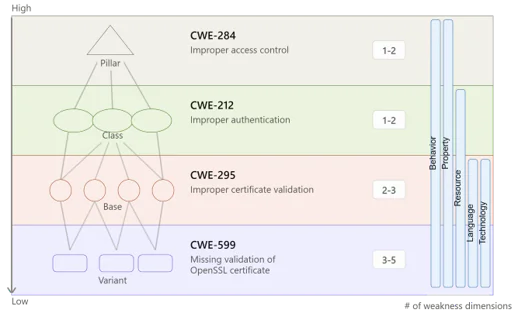
These abstraction levels reflect how much detail a CWE provides. The details can cover factors such as behavior, property, resource, code language, and technology.
MITRE provides some rules for root cause mapping:
- Map a vulnerability at the Base or Variant level whenever possible, since those levels carry enough specificity to be actionable.
- Use a Class-level CWE only when no accurate Base or Variant fits.
- Never map a vulnerability to a CWE Category. A Category, like CWE-725, is a grouping of related weaknesses. It is not itself a weakness, and mapping to one reduces the precision the whole exercise is meant to achieve.
How to Find the Right CWE
Here are some ways to identify accurate weakness mapping(s) for a CVE record.
- Search first. The CWE website has a search box that indexes every page on the site. Use it to search by keyword, by a known CWE-ID, or by a general term. To limit results to individual CWE entry pages, add inurl:definitions to the query.
- Prefer Base or Variant results. When your search returns several candidates, pick the most specific one that accurately describes the mistake, not just the closest match by name. Class-level CWEs may be used as a fallback only when no accurate Base or Variant level CWE exists.
- Avoid Categories. Searching “xss”, for instance, shows CWE-79 as the top result, while a nearby result, CWE-725, is a category that groups related weaknesses together. Skip it in favor of the Base or Variant weakness, as you should never map a vulnerability to a category.
- Verify with a colleague. MITRE’s own best practice is to have a colleague with different skills or experience sanity-check your mapping before you finalize it, since root cause analysis is subjective.
- Each CWE entry also carries a Vulnerability Mapping label and Mapping Notes under its title to guide correct usage. Always review these before finalizing any mapping.
If you exhaust the search and nothing fits, you may have found a real gap in CWE coverage. You can submit it to MITRE for consideration as a new or updated CWE.
For broader navigation, CWE offers “Views”. These are curated slices of the CWE list. When a keyword search returns too much noise, the Developer View (about 400 CWEs) and the NVD View (about 130 CWEs most common in real-world records) are useful shortcuts.
How Should Teams Prioritize CVEs?
A published CVE Record documents a publicly disclosed vulnerability. A CWE tells you what kind of mistake caused it. But they do not tell you whether a vulnerability requires urgent patching or can wait for a later maintenance cycle. That’s the job of scoring systems.
CVSS — Common Vulnerability Scoring System
CVSS is a standardized system for assessing and communicating the severity of vulnerabilities. It rates the severity of a vulnerability on a 0 to 10 scale, based on factors like attack vector, complexity, and the potential impact to confidentiality, integrity, and availability if the vulnerability is exploited. A score of 0.0 means no severity, while scores from 9.0 to 10.0 are considered critical.
However, a CVSS Base score alone doesn’t tell you whether attackers are actively exploiting a given vulnerability in the wild. So relying on CVSS alone can lead to over-prioritization. Security teams end up with queues full of “critical” findings many of which pose little immediate threat, while actively exploited vulnerabilities with lower scores may receive less attention.
EPSS — Exploit Prediction Scoring System
The Exploit Prediction Scoring System (EPSS), maintained by FIRST, predicts the probability that a given CVE will be exploited in the wild within the next 30 days. Scores run from 0 to 1, with higher scores indicating a greater predicted likelihood of exploitation. The model is trained and evaluated using real-world exploitation data, while daily scores respond to current signals such as exploit-code availability, discussions, references, and threat-intelligence activity. These signals inform the model’s predictions but do not mean that exploitation observed today directly determines tomorrow’s score.
CVSS, EPSS, and Reachability
Security teams now combine CVSS and EPSS with reachability analysis to add application-specific context. This enables them to filter findings not only by severity or likelihood but by whether the vulnerable code is actually reachable from the application. This three-layer prioritization approach helps cut vulnerability noise in large codebases.
| Layer | Question it answers | Example signal |
|---|---|---|
| CVSS (severity) | How bad would exploitation be? | 0–10 score based on impact and attack complexity |
| EPSS (likelihood) | How likely is exploitation in the next 30 days? | 0–1 probability based on real-world exploit activity |
| Reachability | Is the vulnerable code actually called? | Whether your application invokes the affected function or dependency |
For example, a critical CVSS score on a library function your application never calls may be a lower priority than a medium-severity flaw in code that runs on every request. Reachability analysis, done manually or through an SCA tool with call-graph awareness, helps security teams build a more focused remediation queue.
What is the CWE Top 25 and How is it Used?
MITRE and CISA publish the CWE Top 25 Most Dangerous Weaknesses annually, ranking weakness types by how often they appear in real vulnerability data and how severe they tend to be. Common familiar patterns include SQL injection, cross-site request forgery, Out-of-bounds Write, Path Traversal, missing authorization, and memory-buffer errors.
Because the CWE Top 25 list is rebuilt every year from fresh CVE data, it serves as a living baseline. And because it highlights common and dangerous weakness patterns, it is often used as a reference for secure coding, security testing, and software assurance programs.
How are CVE and CWE Used in Practice?
Here is how developers and security teams use CVEs and CWEs.
| Use CWE when… | Use CVE when… |
|---|---|
| You are doing code review or threat modeling before release | You are managing patches for software already in production |
| You are configuring a SAST tool’s rule set | You are running SCA against your dependency tree |
| You are writing secure coding standards or training | You are triaging an active incident or an NVD alert |
Let’s look at how CVEs and CWEs are used in day-to-day security work.
| Task | What To Do |
|---|---|
| Identify and patch vulnerabilities | Check CVE Records and vendor advisories to determine whether the product and version you use are affected. Then follow the vendor’s recommended remediation, such as installing an update, upgrading, changing a configuration, or applying a mitigation CVE-2025-53770 in on-premises Microsoft SharePoint Server is a recent example. The fix was to apply the July 2025 security updates, with Microsoft also recommending AMSI and machine-key rotation. |
| Prioritize vulnerabilities | Use CWE to classify a weakness type and its potential impact. Use CVSS, EPSS, and other risk information to prioritize remediation. For example, a CWE-79 (Cross-Site Scripting) finding on a public-facing login page would take priority over a low-impact informational finding in an internal admin tool, even if both were flagged in the same scan. |
| Improve code quality | Use CWE to find and fix recurring weakness patterns in your codebase. If static analysis keeps flagging CWE-835 (loops with an unreachable exit condition) in different files, it’s a signal to investigate whether there’s a common root cause and fix that shared pattern where one exists, while still reviewing each affected occurrence. |
| Integrate with security tools | Configure SAST and SCA tools in your CI/CD pipeline to automatically flag CWE weakness classes in custom code and CVE vulnerabilities in third-party dependencies. |
Integrate with Security Tools
CWE and CVE plug into different tool categories.
- CWE provides a common classification system for software weaknesses that helps SAST tools describe and categorize their findings. Many SAST tools classify or map detected weakness patterns to CWE IDs, although the mapping is not necessarily one-to-one for every rule or finding. Examples include CWE-295 (improper certificate validation), CWE-502 (deserialization of untrusted data), CWE-337 (predictable PRNG seed), CWE-78 (OS command injection), and CWE-1088 (synchronous access of a remote resource without timeout). These are frequently cross-referenced against the OWASP Top 10.
- CVE data is consumed by software composition analysis (SCA) tools, which identify software dependencies and correlate them with known vulnerabilities.
- Patch-management and vulnerability-management platforms consume CVE data to identify affected software on managed endpoints and help teams remediate vulnerabilities.
- The NVD provides CVE data and additional vulnerability information that security tools and teams can use for vulnerability research, assessment, and correlation. It is a vulnerability database and enrichment source, not a dependency scanner.
- CI/CD security tools can consume CVE data to alert teams when known vulnerabilities are identified in software dependencies during the development and delivery process.
FAQ
Which is More Important — CWE or CVE?
Both. They serve different purposes and work best together. CWE helps teams classify and understand weakness patterns, while CVE IDs and Records help teams identify and track known vulnerabilities. The actual prevention and remediation happen through development practices, security tools, patches, configuration changes, and other controls.
What is an Example of CWE vs CVE?
CWE-89 (SQL Injection) describes a weakness type: building SQL queries in an unsafe way that allows attacker-controlled input to alter a SQL statement. CVE-2021-44228, known as Log4Shell, is a specific, trackable vulnerability in Apache Log4j. NVD currently maps it to CWE-917, CWE-502, CWE-400, and CWE-20.
Can One CVE Map to More than One CWE?
Yes. One CVE can have multiple CWE mappings. For example, NVD lists four CWE mappings for Log4Shell (CVE-2021-44228), with three attributed to Apache and one to NIST. Different sources may provide multiple CWE mappings when describing the type or cause of a vulnerability.
Is the CWE Top 25 the Same as the OWASP Top 10?
No. The CWE Top 25 ranks weakness types across all software using real CVE and CVSS data. OWASP’s Top 10 focuses specifically on web application risk categories. They overlap, since both track patterns like injection and access control, but they remain separate lists with different scopes.
Who Decides which CWE a CVE Maps to?
The CVE Numbering Authority that publishes the CVE record usually proposes the initial mapping. A CNA can include the vulnerability type or CWE mapping in the CVE Record, while NVD can add its own enrichment data. NVD doesn’t simply overwrite the CNA’s original mapping, and an NVD page can show CWE information from multiple sources at the same time. MITRE provides root cause mapping guidance to help organizations apply CWE mappings more consistently.
What is EPSS and Why Does it Matter?
EPSS (Exploit Prediction Scoring System) predicts the likelihood that a CVE will be exploited in the real world within the next 30 days. Combine it with CVSS severity reachability, environmental impact, and other risk signals to prioritize remediation. If there is direct evidence that a vulnerability is being actively exploited, FIRST says that evidence should supersede EPSS.
Conclusion / Key Takeaways
Here’s a recap of the core concepts:
- CVE is the identifier: a specific, known vulnerability in a real product, identified by a unique ID, like CVE-2021-44228 (Log4Shell).
- CWE classifies the underlying weakness type or types that can contribute to vulnerabilities, such as CWE-917 or CWE-502.
Mature teams use both: CVE for patch management and incident response, CWE for code review and secure design, while using CVSS, EPSS, and reachability to decide what to fix first.
How Action1 Helps Teams Detect, Prioritize, and Remediate CVEs
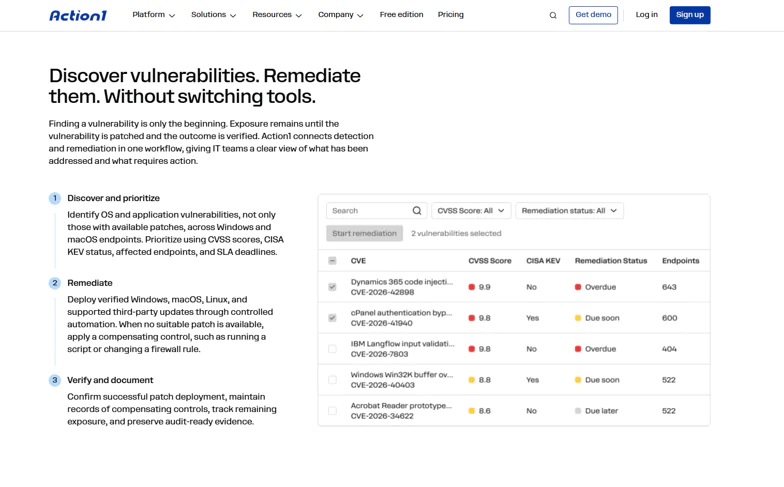
Action1 continuously monitors and identifies vulnerabilities affecting managed Windows and macOS endpoints and third-party applications, then connects vulnerability detection with remediation. It adds context such as CVE IDs, CVSS scores, attack characteristics, CISA Known Exploited Vulnerabilities (KEV) status, publication dates, and ransomware associations, while using multiple vulnerability-intelligence sources rather than relying on the NVD alone.
- Detection and vulnerability intelligence
Action1 identifies vulnerable software and operating systems on managed endpoints and lets teams investigate vulnerabilities by CVE or affected endpoint. A vulnerability record can include the CVE identifier, CVSS score from 0 to 10, attack vector, attack complexity, publication date, CISA KEV status, ransomware association, affected software and versions, and remediation information.
The platform combines vulnerability intelligence from several sources, including VulnCheck NVD++, NIST NVD, CISA, Microsoft Security Response Center (MSRC) and Office data, vendor-provided analysis, and other feeds.
Action1 also provides remediation deadlines based on configurable vulnerability remediation SLAs. For example, teams can define different timeframes for critical, high, medium, and low-severity vulnerabilities and then see whether issues are due soon, due later, or overdue.
- Prioritization
Action1 helps teams focus remediation on vulnerabilities that require the most attention. Its vulnerability-management workflow combines severity and vulnerability context with affected endpoints and remediation deadlines, so teams can identify critical issues, known-exploited vulnerabilities, and vulnerabilities approaching or exceeding their remediation SLA.
Teams can use this information to determine which vulnerabilities to remediate first and apply different remediation timeframes according to their security policies. Action1 also provides dedicated reporting for critical vulnerabilities and known exploited vulnerabilities.
- Remediation and autonomous deployment
Action1 connects vulnerability findings directly to remediation. Depending on the vulnerability, teams can install an available update, remove the affected application, or apply a compensating control when patching is unavailable or not an option. Remediation can be started immediately or scheduled for a later date.
For patch deployment, administrators can use automatic or manual approval workflows and configure deployment schedules and maintenance windows. Offline endpoints can catch up when they reconnect, provided they return within the configured retry window.
With Action1’s update rings, updates can move through staged deployment groups. Success rates and deployment counts automatically determine whether an update should progress to the next ring. This allows teams to validate deployments on a smaller group and catch any issues well in time.
For software distribution, Action1 maintains a private software repository and supports peer-to-peer (P2P) distribution. P2P allows endpoints on the same (local) network to share downloaded update packages, reducing external bandwidth consumption.
- Governance
Action1 supports multi-tenancy for organizations that manage multiple customers, departments, or business units. Each organization can have separately managed endpoints and data, while administrators can manage them through the same console.
Customizable role-based access control (RBAC) lets organizations control which users can access specific Action1 functionality and endpoints. This assists with the least-privilege model and allows responsibilities to be separated between administrators, operators, and other users.
- Verification and reporting
Action1 provides real-time visibility into vulnerability and patch status, including affected endpoints, vulnerable software, remediation status, and deployment results. Its built-in vulnerability reports include CVE, CVSS, CISA KEV status, publication date, affected software, remediation status, and affected endpoint counts.
The platform also provides 100+ built-in customizable report templates that cover vulnerabilities, patching, software and hardware inventory, and security configuration. Teams can easily use them for compliance and audit reporting.
- Linux vulnerability management
Action1 supports Linux patching, including distributions such as Ubuntu, RHEL, CentOS, and Debian. However, Linux does not yet receive the same CVE-level vulnerability assessment and prioritization available for Windows and macOS. Linux vulnerability assessment and prioritization is planned for a future capability.
- Free vulnerability assessment and free tier
Action1 offers a one-time vulnerability assessment for an unlimited number of endpoints. After the initial assessment, the platform remains fully functional and free for the first 200 endpoints, with no feature limitations or expiration.