

A vulnerability management framework provides structured guidance for identifying, assessing, prioritizing, remediating, and verifying security vulnerabilities. It helps organizations establish a consistent approach to managing vulnerabilities instead of relying on occasional scans, undocumented priorities, or unclear responsibilities.
Your vulnerability management program puts that guidance into practice through defined workflows, assigned responsibilities, security tools, and remediation policies. Adopting a framework does not automatically create an effective program. You still need to adapt its guidance to fit your infrastructure, risk exposure, and compliance obligations.
NIST, CISA, and SANS all offer different approaches to vulnerability management. This guide compares their guidance alongside other relevant frameworks and standards, explains how to choose the right approach, and shows how to turn it into a practical vulnerability management program.
Key Takeaways About Vulnerability Management Frameworks
- Choose the right framework: Use NIST, CIS Controls, ISO/IEC 27001, or PCI DSS based on organizational needs and compliance requirements.
- Follow a continuous lifecycle: Plan, discover assets, scan, prioritize, remediate, verify, and report.
- Prioritize risks: Combine CVSS, EPSS, CISA KEV, asset criticality, and business impact.
- Define accountability: Assign responsibilities using RACI matrices and establish remediation SLAs.
- Overcome operational challenges: Address inventory gaps, patch failures, and fragmented tools through automation.
- Measure effectiveness: Track MTTR, patch success, asset coverage, and SLA compliance.
- Streamline remediation: Use Action1 for endpoint visibility, automated patching, verification, and reporting.
Build a more effective vulnerability management program with Action1. Discover vulnerable software, deploy security updates, and track remediation progress. Sign up free for up to 200 endpoints, fully featured, or schedule a demo to see its capabilities.
What is the Difference Between a Vulnerability Management Framework, Standard, Control Set, and Program?
These terms are distinct yet complementary:
| Term | Definition |
|---|---|
| Framework | An organized structure of principles, functions and outcomes that guides security activities. For example, the NIST Cybersecurity Framework (CSF) 2.0 helps organizations manage cybersecurity risk. |
| Standard | A formally published set of requirements or specifications. ISO/IEC 27001:2022 establishes requirements for an information security management system (ISMS), while PCI DSS defines security requirements for organizations handling payment account data. |
| Control or safeguard set | A collection of specific security measures an organization implements to reduce risk. NIST SP 800-53 Rev. 5 and CIS Controls v8.1 provide examples, including safeguards relevant to vulnerability identification, patching and system maintenance. |
| Assessment methodology | A defined method for evaluating an organization’s security practices, identifying gaps, and measuring improvement. CISA’s Cyber Resilience Review (CRR), for example, is an assessment method that evaluates an organization’s cybersecurity practices and operational resilience. It does not replace a vulnerability management framework or program. |
| Vulnerability management program | The system an organization builds using selected frameworks, standards, controls, and assessment results. It includes policies, scanning schedules, risk-based remediation SLAs, assigned owners, verification procedures, and reporting. |
| Vulnerability assessment | An activity within the program that identifies and evaluates vulnerabilities in systems, applications and other assets. It is a point-in-time assessment of weaknesses. It feeds the program but is not the program. |
Each resource addresses a different need. An organization might use NIST CSF 2.0 to organize its cybersecurity risk management, NIST SP 800-53 to select security controls, NIST SP 800-40 Rev. 4 to guide patch management, and PCI DSS to meet payment security requirements. Its vulnerability management program connects these requirements through internal processes.
The following table explains how each resource contributes and what it does not replace.
| Source | Type | Primary purpose | Role in vulnerability management | What it does not replace |
|---|---|---|---|---|
| NIST CSF 2.0 | Cybersecurity framework | Organize and communicate cybersecurity risk management through six functions: Govern, Identify, Protect, Detect, Respond, and Recover. | Provides an organization-wide structure for governing vulnerability risk, identifying assets and weaknesses, and coordinating response. | Detailed vulnerability scanning procedures, remediation SLAs, or patch deployment workflows. |
| NIST SP 800-40 Rev. 4 | Technical guidance | Establish an enterprise-wide patch management strategy and lifecycle. | Guides patch identification, prioritization, acquisition, installation and verification as preventive maintenance. | A complete vulnerability management program or broader security control catalog. |
| NIST SP 800-53 Rev. 5 | Security and privacy control catalog | Provide customizable security and privacy controls for federal and enterprise systems. | Defines specific control baselines relevant to vulnerability monitoring/scanning (RA-5) and flaw remediation (SI-2). | An implementation plan, automated vulnerability scanner, or operational remediation process (lists controls, not workflows) |
| CIS Controls v8.1 | Prioritized security control set | Provide prioritized, actionable defensive safeguards against common cyberattacks. | Controls 1, 2 and 7 address asset inventory, software inventory, and continuous vulnerability management respectively. | High-level risk analysis, governance policy design, or a complete compliance standard. |
| ISO/IEC 27001:2022 | International ISMS Standard | Define requirements for establishing, implementing, and maintaining an information security management system (ISMS). | Mandates risk-based management of technical vulnerabilities (Annex A 8.8) within a certified governance framework. | Scan frequencies, specific tooling, operational SLAs, or granular patch instructions. |
| PCI DSS v4.0.1 | Industry security standard | Protect payment account data through technical and operational security requirements. | Requirements 6.3.1 and 6.3.3 address vulnerability identification, risk ranking and security patch installation; Requirement 11.3 covers internal and external vulnerability scanning. | Enterprise-wide vulnerability management outside the defined cardholder data environment (CDE). |
| CISA Cyber Resilience Review (CRR) | Assessment methodology | Evaluate cybersecurity practices and operational resilience across critical infrastructure. | Identifies gaps in risk management, asset management and protective controls that can affect vulnerability management. Supplemental Resource Guide, Volume 4: Vulnerability Management provides guidance for building and improving that capability. | A vulnerability management framework, security standard, or technical scanning procedure. |
| OWASP Vulnerability Management Guide (VMG) | Practitioner guide | Help organizations discover, manage, and remediate application-level security vulnerabilities. | Provides specialized lifecycle guidance for application development security, threat modeling, and code-level remediation. | A formal compliance standard or certification framework. |
| SANS Vulnerability Management Maturity Model (VMMM) | Program maturity model | Help organizations evaluate and improve vulnerability management maturity. | Assesses five focus areas: Prepare, Identify, Analyze, Communicate and Treat, across five maturity levels. | A formal security standard, control catalog or complete compliance framework. |
Why Does a Vulnerability Management Framework Matter?
A vulnerability management framework helps you move from reactive security fixes to a planned, risk-based process. Without one, teams can miss critical vulnerabilities and struggle to demonstrate that sensitive information and systems are protected. A structured approach improves security operations in several ways.
Identify Risks Proactively
A framework establishes regular vulnerability scanning, asset discovery, and threat monitoring so teams can identify weaknesses before attackers exploit them. The volume of disclosed vulnerabilities makes this essential. According to the CVE Program’s annual publication statistics, 40,077 CVE records were published in 2024 and 48,244 in 2025, an increase of approximately 20.38%. These figures reflect NVD’s published vulnerability records, not the number of vulnerabilities affecting every organization.
Align Security Practices with Compliance Requirements
Several regulations and security standards expect organizations to assess risks, maintain security measures, and document their effectiveness.
- HIPAA: The Security Rule requires covered entities and business associates to conduct risk analysis and implement risk management measures to protect electronic protected health information (ePHI).
- PCI DSS: Requires vulnerability identification, risk ranking, regular internal and external scans, and timely installation of security patches.
- GDPR: Article 32 requires risk-appropriate technical and organizational security measures, including regular testing and assessment of their effectiveness.
- FISMA: Requires US federal agencies to maintain documented, risk-based information security programs by implementing NIST SP 800-53 controls, such as RA-5 (Vulnerability Monitoring) and SI-2 (Flaw Remediation).
Allocate Resources Efficiently
Risk-based prioritization helps teams fix critical vulnerabilities first instead of treating every finding equally. Security teams can consider severity, known exploitation, threat intelligence, asset exposure, and business impact when assigning remediation deadlines. This directs limited IT resources toward the weaknesses that pose the greatest risk.
Build a Holistic Security Approach
Vulnerabilities extend beyond missing software patches. Misconfigurations, exposed services, outdated applications, and weak access controls can also create exposure. A framework brings these issues into a coordinated process covering endpoints, servers, networks, cloud infrastructure, and applications. When one process covers scanning, patching, configuration and exceptions, silos between teams break down.
Strengthen Organizational Credibility and Trust
Documented policies, assigned responsibilities and verified remediation give management, auditors and customers evidence that security risks are actively managed. IBM’s Cost of a Data Breach Report 2026 puts the global average cost of a breach at USD 4.99 million, reinforcing the financial consequences of inadequate protection.
Adopting a Proactive, Holistic Approach to Vulnerability Management
Ad hoc vulnerability management typically follows a reactive scan-and-patch pattern. Teams run scans periodically, review findings, fix issues and move on. This approach can leave critical vulnerabilities unresolved and overlook weaknesses such as misconfigurations and excessive permissions.
A framework-driven approach follows a proactive, continuous cycle. It connects asset discovery, vulnerability scanning, risk assessment, prioritization, remediation and verification. It also assigns responsibility for each stage and accounts for technical and human factors that affect security.
| Area | Ad hoc approach | Framework-driven approach |
|---|---|---|
| Cadence | Occasional scans | Defined scanning schedule plus continuous monitoring |
| Prioritization | Severity scores or individual judgment | Risk-based priorities using severity, exploit likelihood, known exploitation, asset criticality, and business impact |
| Ownership | Unclear or informally assigned | Defined roles and accountability |
| Verification | Ticket closed means a fix worked | Confirms remediation through rescanning or other validation |
| Reporting | Informal updates such as raw scan exports | Documented metrics, role-specific reports, trends with SLA data |
The difference is obvious: teams know which vulnerabilities to fix first, who owns remediation, and how to confirm that the work is complete.
What are the Seven Phases of a Vulnerability Management Framework?
A vulnerability management framework operates as a continuous cycle. Each phase produces information or evidence that informs the next, helping teams identify weaknesses, evaluate risk, coordinate remediation and confirm that fixes work. The cycle also assigns ownership and produces documented outputs, making it easier to track progress, demonstrate accountability, and improve security practices.
The table summarizes the lifecycle phases of a vulnerability management framework:
| Phase | Goal | Key activities | Output | Owner |
|---|---|---|---|---|
| 1. Planning and scoping | Define what is covered and how | Set scope, policies, roles, cadence, deadlines | Vulnerability management policy, scope document, and responsibility matrix | Security lead |
| 2. Asset discovery | Know every asset | Inventory, identify and classify hardware, software and connected assets | Asset register with ownership, software versions, and criticality tags | IT operations |
| 3. Vulnerability scanning | Detect weaknesses in the environment | Authenticated, agent and network scans | Raw findings | Security team |
| 4. Risk assessment and prioritization | Evaluate risk and decide what to fix first | Score, add threat context, remove false positives | Risk-ranked remediation queue | Security team |
| 5. Remediation | Remove or reduce the risk | Patch, reconfigure, apply compensating controls | Remediation records and approved exceptions | IT operations, app owners |
| 6. Verification | Confirm that the fix worked | Rescan, regression check | Verification record | Security team |
| 7. Reporting | Inform and improve | Metrics, audit evidence, lessons learned | Reports and plan updates | Security lead |
Planning and Scoping
Planning is the first step in establishing a vulnerability management process.
- Define which systems fall within scope, including on-premises infrastructure, cloud workloads, remote endpoints, applications, network devices and operational technology (OT).
- Assign responsibilities to security teams, IT administrators, system owners and compliance personnel.
- Select scanning and remediation tools.
- Set assessment schedules and define escalation procedures.
- Document remediation deadlines in a vulnerability management policy that specifies SLAs by severity, exploitation status, and business risk.
Asset Discovery and Inventory
Make sure every asset enters your vulnerability detection and remediation workflow.
- Maintain an inventory of hardware, software, cloud workloads, containers, applications, and connected devices on your network.
- Classify assets by business criticality, data sensitivity, exposure, and ownership.
- Pay particular attention to unmanaged laptops, shadow cloud instances, and remote devices that remain off-network during scheduled scans. Find them through network discovery, cloud provider APIs, and agent check-ins, then reconcile against your directory.
Vulnerability Scanning
Vulnerability scanning identifies known security weaknesses in inventoried assets.
- Use authenticated scans to inspect system configurations, installed software, and missing patches.
- Unauthenticated network scans help identify externally visible weaknesses, exposed services, and potential entry points.
- Agent-based scanning provides visibility into remote and off-network endpoints, while network-based scanning assesses reachable systems without an installed agent.
- Set continuous or scheduled scanning cadences according to asset risk and change frequency.
- Manually validate findings when scan coverage is incomplete, results conflict, or scanners cannot assess a particular system.
Risk Assessment and Prioritization
This is the most important phase because the order in which you fix vulnerabilities determines how effectively you reduce exposure. Start with the Common Vulnerability Scoring System (CVSS) to understand technical severity. Then use the Exploit Prediction Scoring System (EPSS) to estimate exploitation probability, check the CISA Known Exploited Vulnerabilities (KEV) Catalog for confirmed exploitation, and consider the affected asset’s business criticality.
Consider this example:
| Factor | Vulnerability A | Vulnerability B |
|---|---|---|
| CVSS score | 9.8 (Critical) | 9.8 (Critical) |
| EPSS score | 0.12 (12%) | 0.94 (94%) |
| CISA KEV status | Not listed | Listed |
| Affected asset | Internal test server | Internet-facing production server |
| Priority | High | Urgent |
| Example deadline | 7 days | 24 hours |
Both vulnerabilities have identical CVSS scores, but Vulnerability B presents greater immediate risk because it has a much higher predicted exploitation probability, appears in the KEV Catalog, and affects an internet-facing production system. Your team should prioritize B and fix the most critical issues first.
According to First, EPSS estimates the probability of exploitation activity being observed within the next 30 days; it is not a complete risk score. KEV listing provides evidence of known exploitation and should take precedence over a low EPSS prediction.
Also eliminate false positives by validating affected software versions, configurations, and exposure before assigning remediation work.
Why is Relying Only on NVD Risky for Vulnerability Prioritization?
A framework must also account for limitations in vulnerability data sources. NIST reported a significant National Vulnerability Database (NVD) enrichment backlog beginning in early 2024. On April 15, 2026, NIST introduced risk-based enrichment priorities focusing on CISA’s KEV catalog, federal software, and critical software defined under Executive Order 14028. Earlier backlogged records were moved into a lower-priority tier not scheduled for immediate enrichment, and NIST no longer routinely adds its own severity score when a CVE’s original publisher has already supplied one.
This does not mean those CVEs disappeared from the NVD. It means metadata such as standardized severity scoring and affected-product mappings (CPEs) may be incomplete or delayed. A vulnerability management program that depends exclusively on NVD enrichment can therefore miss important context or receive it late.
Use multiple sources, including vendor security advisories, the CVE Program, CISA’s KEV Catalog and threat intelligence feeds. Cross-check affected software versions and validate findings against your own asset inventory. This gives your team more actionable information for prioritizing remediation.
Remediation and Mitigation
Once priorities are set, select the appropriate response. You can install a security patch, reconfigure the affected system, apply a compensating control, or formally accept the risk with documented approval and an expiration or review date. Test patches in a staging environment before deployment. Use phased rollouts to limit disruption. NIST SP 800-40 Rev. 4 recommends this staged approach. Maintain rollback procedures if updates cause problems.
The following are example remediation SLAs, not universal regulatory or framework requirements. Adjust to your risk tolerance and compliance duties.
| Severity tier | Remediation deadline (example) | If no patch exists |
|---|---|---|
| Critical, or any KEV-listed vulnerability on an exposed asset | 3 days | Mitigate within 24 hours |
| Critical, not on KEV | 14 days | Mitigate within 7 days |
| High | 30 days | Mitigate within 14 days |
| Medium | 60 days | Review at the next cycle |
| Low | 90 days or next maintenance window | Accept with documented approval |
Verification and Validation
Rescan affected systems or use other appropriate validation methods to confirm that remediation succeeded. Check that the vulnerable software version is no longer present, the relevant configuration has changed, and the system remains functional. Look for regressions or incomplete deployments, especially when patches are applied to large endpoint groups. Closing a remediation ticket does not prove that the vulnerability is gone. Verification provides the evidence that the exposure has been addressed.
Reporting and Documentation
Report differently for each audience.
- Executives need risk trends and exposure summaries.
- IT administrators need open remediation tasks, affected endpoints, and overdue work.
- Auditors need policies, assessment records, approvals, and verification evidence.
Track metrics such as mean time to remediate (MTTR), mean time to patch (MTTP), SLA compliance percentage, and the number of overdue critical vulnerabilities. Use these results for continuous improvement: adjust scanning coverage, remediation priorities, and resource allocation in the next planning cycle. See the ‘How Do You Implement a Vulnerability Management Framework?’ section for practical steps to strengthen these processes.”
Which Vulnerability Management Framework is Best for Your Organization?
The right vulnerability management framework depends on your organization’s needs, size, industry, regulatory obligations, and security maturity. Some frameworks provide strategic direction, while others offer detailed vulnerability management practices, technical controls and assessment methods.
The following table compares ten frameworks, standards, control sets, and guidance resources. They differ in scope and implementation effort, so you may need to combine several rather than select just one.
| Framework | Publisher | Type | Best for | VM-specific depth | Compliance mapping | Effort* |
|---|---|---|---|---|---|---|
| NIST CSF 2.0 | NIST | Framework | Organizations building a governance structure | Low: outcomes only | Strong: maps to HIPAA, FISMA, ISO | Medium |
| NIST SP 800-40 Rev. 4 | NIST | Guidance | Teams that patch many endpoints and servers | High for patching | Supports FISMA and 800-53 SI-2 | Medium |
| NIST SP 800-53 Rev. 5 | NIST | Control catalog | Federal agencies and contractors | Medium: RA-5, SI-2 | Native to FISMA and FedRAMP | High |
| CIS Controls v8.1 | Center for Internet Security (CIS) | Control set | SMBs implementing practical security safeguards | Medium. Control 7: Continuous Vulnerability Management | Crosswalks to NIST, ISO, PCI | Low to medium |
| ISO/IEC 27001:2022 | ISO and IEC | Certifiable standard | Firms that need an auditable information security management system | Low: Annex A 8.8 addresses management of technical vulnerabilities | Supports ISMS certification and information security governance | High |
| PCI DSS v4.0.1 | PCI Security Standards Council | Industry security standard | Organizations storing, processing, or transmitting payment account data | Medium: Requirements 6.3.3 and 11.3 cover vulnerability management, patching, and scanning | PCI audits and attestation | Medium to high |
| CISA CRR Vol. 4 | CISA / CERT-CC | Assessment guide | Smaller organizations formalizing a vulnerability management program | Medium: full cycle, high level | Maps to NIST CSF sub-categories | Low |
| SANS VMMM & PIACT | SANS Institute | Maturity model | Programs measuring and improving maturity | High. Five focus areas: Prepare, Identify, Analyze, Communicate, and Treat | No built-in regulatory mapping | Medium to high |
| OWASP VM Guide | OWASP Foundation | Community guidance | Application security and software development teams | High for application code | No formal compliance mapping | Low to medium |
| ENISA guidance and EUVD | EU Agency for Cybersecurity | Guidance and database | Organizations in the EU under NIS2 | Medium: vulnerability handling, disclosure, risk assessment, and threat-informed prioritization | Aligned to NIS2 | Medium to high |
*The effort ratings are estimates, not ratings published by these organizations. They reflect the work required to interpret, implement and maintain each resource. Low means weeks, medium means a quarter, high means a formal project.
CISA Cyber Resilience Review: Vulnerability Management Guidance
CISA provides the Cyber Resilience Review (CRR), an assessment that helps organizations evaluate their cybersecurity practices. Its CRR Supplemental Resource Guide, Volume 4: Vulnerability Management provides specific guidance for developing a vulnerability management capability. Originally published in 2016 by Carnegie Mellon University’s Software Engineering Institute, the guide is particularly useful for smaller organizations formalizing a program for the first time. It covers strategy, planning, implementation, assessment and improvement. Note that Volume 4 carries a 2016 copyright, so pair it with current sources.
CISA also provides resources that strengthen vulnerability prioritization:
- KEV Catalog: A continuously updated list of vulnerabilities that have been exploited in the wild.
- Binding Operational Directive (BOD) 26-04: Requires US federal civilian executive branch agencies to remediate listed KEVs within risk-based deadlines of 3, 14 and 60 days. It weighs public exposure, KEV listing, whether an attack can be automated, and technical impact.
- Stakeholder-Specific Vulnerability Categorization (SSVC): Uses decision trees with four outcomes (Track, Track*, Attend, and Act) to help organizations prioritize vulnerability responses according to exploitation, impact, and organizational context.
CISA CRR’s Four-Stage Vulnerability Management Cycle
The CRR Volume 4 guide organizes vulnerability management into four connected stages:
- Strategy: Define the vulnerability analysis and resolution strategy, including scope, assessment methods, and resources.
- Plan: Document procedures, tools, information sources, roles and responsibilities, and performance measures.
- Implementation: Assess vulnerabilities, prioritize findings, and manage exposure.
- Assessment: Evaluate effectiveness, analyze root causes, and identify improvements.
Assessment results feed into the next strategy cycle, closing the loop.
Benefits: Encourages Best Practices, Flexible, Data-Informed
The CRR is flexible and grounds your program in recognized best practices. It provides a practical structure that organizations can adapt to their resources and risk. It encourages measurable outcomes, documented processes, and root cause analysis. Teams can use assessment results to identify recurring weaknesses and make data-informed improvements.
Limitations: Lacks Detailed Guidance, May Not Suffice for Larger Organizations
The guide stays high level. It does not prescribe detailed technical configurations, comprehensive control requirements, or enterprise-wide implementation procedures. Organizations with complex infrastructure may need NIST controls, specialized technical guidance, and additional governance processes.
NIST Vulnerability Management Guidance: CSF 2.0, SP 800-40, and SP 800-53
NIST publishes several complementary resources.
- The Cybersecurity Framework (CSF) 2.0 provides organization-wide cybersecurity risk management guidance.
- SP 800-40 Rev. 4, published in April 2022 as the Guide to Enterprise Patch Management Planning, covers patching as preventive maintenance.
- SP 800-53 Rev. 5 provides security controls, including RA-5 (Vulnerability Monitoring and Scanning) and SI-2 (Flaw Remediation).
Use the CSF to structure governance, SP 800-40 to plan patching, and SP 800-53 when an auditor or contract names specific controls.
NIST CSF 2.0: Six Cybersecurity Functions
NIST released CSF 2.0 in February 2024, and it added a sixth function, Govern.
- Govern: Establish vulnerability management policies, ownership, risk tolerance, and SLAs.
- Identify: Maintain asset inventories and identify vulnerabilities.
- Protect: Apply patches, secure configurations, and harden systems.
- Detect: Monitor continuously and watch threat intelligence for new exploitation.
- Respond: Coordinate remediation and mitigation when vulnerabilities create security risk.
- Recover: Restore affected systems and operations following an incident.
These functions operate concurrently rather than as a sequential vulnerability management checklist.
NIST SP 800-40 Rev. 4: Patch Management Lifecycle
NIST SP 800-40 Rev. 4, published in April 2022, frames enterprise patch management as routine preventive maintenance. Its lifecycle moves from knowing when vulnerabilities affect your assets, to planning the risk response, to executing it, with continuous monitoring throughout. You group assets with similar maintenance needs and assign each group a maintenance plan for routine patching, emergency patching, emergency mitigation, and unpatchable assets. Its four risk responses are accept, mitigate, transfer, and avoid.
SANS Vulnerability Management Maturity Model (VMMM)
The SANS Institute is a training and research organization whose practitioner guidance is widely used by security teams. Its Vulnerability Management Maturity Model (VMMM), introduced in 2020 and built from the SANS MGT516 course, organizes the work into five focus areas: Prepare, Identify, Analyze, Communicate, and Treat (PIACT). Each of these areas contains sub-areas such as Policy and Standards, Prioritization, Metrics and Reporting, and Patch Management, and each is rated on five maturity levels.
The Five Maturity Levels of the SANS VMMM
SANS defines five maturity levels. The following examples illustrate how vulnerability management practices can progress through them, using policy and process implementation as observable indicators.
| Level | Maturity stage | Observable characteristics |
|---|---|---|
| 1 | Initial | Vulnerability scanning is ad hoc, with undocumented policies and reactive remediation. |
| 2 | Managed | Basic policies and procedures exist, often introduced in response to operational problems or audit findings. |
| 3 | Defined | Documented policies reflect recognized security practices, with defined responsibilities and staff training. |
| 4 | Quantitatively Managed | Teams measure policy adherence, track exceptions, and monitor program performance. |
| 5 | Optimizing | Automated controls enforce policies, identify deviations, and feed results into continuous improvement. |
These levels come from the SANS VMMM, not the separate SANS Security Awareness Maturity Model. Organizations should assess maturity for individual PIACT focus areas since every part of the program may not be operating at the same level.
SANS offers practical guidance for teams that want to improve program maturity, but its model requires time, skilled personnel, and consistent measurement. It does not provide built-in regulatory compliance mappings. Pair it with NIST or ISO/IEC 27001 when you need formal control references and audit evidence.
OWASP Vulnerability Management Guide (VMG)
The Open Worldwide Application Security Project (OWASP) provides resources for application security and broader vulnerability management. Its Vulnerability Management Guide (VMG) helps organizations establish repeatable processes to identify, assess, prioritize, report, and remediate vulnerabilities across the vulnerability management lifecycle. Covering preparation, scanning, reporting, and remediation, the guide pairs naturally with related OWASP resources like the Top 10 list of web application risks and the Dependency-Check tool, which flags known-vulnerable libraries. Information security practitioners, IT professionals, and business leaders can use the VMG with infrastructure-focused frameworks to build an organization-wide vulnerability management program.
The VMG provides lifecycle guidance rather than mandatory compliance requirements, so organizations may need additional standards for regulatory obligations. Its repeatable-cycle approach helps organizations structure vulnerability management activities around their needs and available resources. However, it is guidance rather than a formal standard and does not provide regulatory compliance mappings or mandatory remediation deadlines.
ISO/IEC 27001:2022 and Technical Vulnerability Management
ISO/IEC 27001 is an international standard for establishing, implementing, and continually improving an information security management system (ISMS). Its Annex A control 8.8, Management of technical vulnerabilities, addresses how organizations obtain information about technical vulnerabilities, evaluate exposure, and take appropriate measures. It suits organizations seeking formal ISMS certification but requires additional technical procedures to manage vulnerability scanning and remediation.
CIS Controls v8.1: Continuous Vulnerability Management
CIS Controls are a prioritized list of safeguards that organizations can implement to defend against common cyberattacks. Control 7, Continuous Vulnerability Management, is particularly relevant. It has seven safeguards: 7.1 vulnerability management process, 7.2 remediation process, 7.3 automated operating system patching, 7.4 automated application patching, 7.5 internal scans, 7.6 external scans, and 7.7 remediating detected vulnerabilities. This makes CIS a practical starting point for SMBs.
PCI DSS v4.0.1: Vulnerability Scanning and Patching Requirements
The Payment Card Industry Data Security Standard (PCI DSS) applies to organizations that store, process or transmit payment account data. Requirement 6.3.3 of PCI DSS v4.0.1 states: “Patches/updates for critical vulnerabilities … are installed within one month of release.” Other applicable security patches must be installed within an appropriate timeframe based on the entity’s risk assessment. Requirement 11.3 addresses internal and external vulnerability scanning, including resolving high-risk and critical findings and verifying remediation.
ENISA Vulnerability Management and NIS2 Guidance
ENISA publishes practitioner guidance rather than a certifiable standard. It also operates the European Vulnerability Database (EUVD) and has been serving as a CVE Program Root since November 2025. Its June 2025 Technical Implementation Guidance (Section 6.10) outlines NIS2 vulnerability handling and disclosure practices, recommending severity assessment via CVSS and EPSS supplemented by environmental and threat context. EU organizations typically pair ENISA’s guidance and EUVD intelligence with a certifiable management framework such as ISO/IEC 27001.
ENISA’s guidance translates NIS2-related cybersecurity requirements into practical implementation advice, examples of evidence, and mappings to recognized standards. It helps covered organizations understand vulnerability handling expectations. However, its scope is tied to specific EU regulatory requirements and covered entities, so it is not a universal framework for all organizations.
Improve your vulnerability management lifecycle with Action1. Connect the discovery of vulnerable software to patch deployment and remediation reporting. Sign up free for up to 200 endpoints, fully featured, or schedule a demo to see the complete workflow.
How Do You Implement a Vulnerability Management Framework?
Once you understand the vulnerability management lifecycle, implementation begins by choosing a reference framework, assigning responsibilities, connecting tools, establishing remediation policies, and measuring results. The following six steps help you turn external guidance into a vulnerability management program.
Steps to Implement a Vulnerability Management Framework
Define Scope and Stakeholders
Start by identifying the systems and assets your program must cover, including endpoints, servers, network devices, cloud workloads, containers, and applications. Identify stakeholders from security, IT operations, application development, and leadership. Assign responsibility for vulnerability identification, prioritization, remediation approval and verification. Document regulatory obligations, business-critical systems, and existing security processes to establish a clear starting point.
Choose a Reference Framework
Select a framework or standard that matches your organization’s needs, industry, size, and compliance obligations. Use the comparison table in the Which Vulnerability Management Framework Is Best for Your Organization section to evaluate your options. For example, CIS Controls v8.1 offers practical implementation safeguards, NIST provides broader risk management and technical control guidance, and ISO/IEC 27001 supports an auditable information security management system. You can combine resources, but designate one primary reference to anchor your policies and processes.
Select and Integrate Tools
Choose tools that provide visibility into your technology environment and support the complete vulnerability lifecycle. Integrate vulnerability scanners with endpoint management platforms, IT service management (ITSM) or ticketing systems, and CI/CD pipelines. Connect threat intelligence sources such as CISA’s KEV Catalog and EPSS data to improve prioritization. Automate ticket creation, ownership assignment, and remediation tracking where possible.
Set Risk Scoring and Remediation SLAs
Define how your team will evaluate and prioritize vulnerabilities. Combine CVSS severity, EPSS exploitation probability, KEV status, asset criticality, and exposure rather than relying on severity scores alone. Establish remediation SLAs for critical, high, medium, and low-risk findings. Document escalation procedures, exception approvals, and risk acceptance rules so teams understand when issues must be fixed and who can authorize delays.
Plan and Execute Remediation
Translate prioritized findings into remediation tasks. Decide whether an issue requires patching, configuration changes, compensating controls, or documented risk acceptance. Track exceptions with an owner and an expiry date. Test updates in staging environments before deploying them to production. Use phased rollouts to reduce disruption, monitor deployment results, and maintain rollback procedures. Coordinate with application and system owners to schedule maintenance without compromising business operations.
Monitor KPIs and Improve
Track program performance through measurable KPIs. Useful metrics include mean time to remediate (MTTR), mean time to patch (MTTP), remediation SLA compliance, vulnerability recurrence, and the percentage of assets covered by scanning. Review these metrics regularly with security and IT teams. Investigate recurring weaknesses, overdue remediation, and blind spots in asset coverage, then update policies, tools, and workflows. This continuous improvement process keeps the program aligned with changing infrastructure and risk.
Vulnerability Management Roles and RACI Matrix
A responsibility assignment matrix helps prevent delays caused by unclear ownership. Use the following RACI model when implementing your program:
- R (Responsible): Performs the work.
- A (Accountable): Owns the outcome and approves decisions.
- C (Consulted): Provides input.
- I (Informed): Receives updates.
| Activity | Security | IT operations | App owners | Leadership |
|---|---|---|---|---|
| Scan | A/R | C | I | I |
| Prioritize | A/R | C | C | I |
| Patch | C | A/R | R* | I |
| Approve exceptions | R | C | C | A |
| Verify | A/R | C | C | I |
| Report | R | C | C | A |
*Application owners are responsible for coordinating or executing application-specific fixes, while IT operations may handle deployment infrastructure and endpoint patching.
Assign one accountable owner for each activity in your RACI matrix.
How Do You Map Multiple Frameworks Without Duplicating Controls?
Organizations may need to satisfy multiple frameworks, standards, and control sets, but they should not create a separate process for every overlapping requirement. Instead, build one internal vulnerability management program and map each external requirement to the process that fulfills it. This approach reduces duplicate work while preserving the evidence needed for audits and compliance reviews.
Use the following method:
Establish One Internal Requirement
Define a single operational requirement for each activity, such as maintaining an asset inventory, scanning for vulnerabilities, prioritizing findings, or deploying patches within approved timelines.
Map Equivalent External Requirements
Link the internal requirement to relevant NIST controls, CIS Safeguards, ISO 27001 controls, and so on. Make a note of partial matches.
Assign One Accountable Owner
Give each internal requirement an owner, even when several teams perform the work.
Define an Authoritative Evidence Source
Use one primary record, such as a vulnerability management platform or ticketing system. Identify any additional evidence required by a specific framework.
Identify Genuine Gaps
Compare what your process does with each mapped requirement. Add controls or procedures only when an external requirement introduces an obligation that your existing process does not meet.
Review Mappings When Requirements Change
Reassess the mapping when a framework is revised, a new regulation applies, or your infrastructure and risk profile change.
The following table maps internal process requirements to external frameworks:
| Internal requirement | NIST mapping | CIS mapping | ISO / PCI mapping | Owner | Evidence | Review trigger |
|---|---|---|---|---|---|---|
| Maintain an asset inventory | CSF 2.0: ID.AM; SP 800-53: CM-8 | Control 1 and 2 | ISO 27001 Annex A 5.9; PCI DSS 12.5.1 | IT operations | Inventory export | Quarterly, new systems, or major infrastructure change |
| Identify and assess vulnerabilities | SP 800-53: RA-5; CSF: ID.RA | 7.5, 7.6 | ISO 27001 Annex A 8.8; PCI DSS 11.3.1, 11.3.2 | Security team | Scan reports and assessment records | New vulnerabilities or scanning requirement changes |
| Rank vulnerabilities by risk | CSF: ID.RA; SP 800-53: RA-7 | 7.1, 7.2 | ISO 27001 Annex A 8.8; PCI DSS 6.3.1 | Security lead | Risk register and prioritization records | Change in scoring data sources, like threat intelligence or risk criteria |
| Remediate within SLA | SP 800-53: SI-2; SP 800-40 Rev. 4 | 7.2, 7.3, 7.4, 7.7 | ISO 27001 Annex A 8.8; PCI DSS 6.3.3 | IT operations | SLA compliance report | Missed SLA, new directive, revised patch requirements |
| Verify remediation | SP 800-53: SI-2; CA-2 | 7.7 | ISO 27001 Annex A 8.8; PCI DSS 11.3.1, 11.3.2 | Security team | Rescan results and closure records | Audit findings or changes to validation procedures |
| Approve exceptions | SP 800-40 Rev. 4 risk responses | 7.2 | ISO 27001 6.1.3; PCI DSS 11.3.1.1 | Security lead | Exception register with expiry | Expiry date or repeated exceptions |
Mappings are starting points, not claims of automatic compliance. Confirm the applicable control wording, scope, and evidence requirements in the current version of each standard. An internal process can support several frameworks, but it does not eliminate framework-specific obligations.
What Makes Vulnerability Management Frameworks Hard to Implement?
To implement a vulnerability management framework, IT and security teams must work around fragmented tools, incomplete asset data, limited capacity, operational constraints, and vulnerabilities that keep emerging. Following are the main challenges with practical ways to address them.
Tool Overload and Fragmented Workflows
Teams commonly use separate scanners, endpoint management platforms, ticketing systems, and threat intelligence feeds that do not share data consistently. This creates duplicate findings, manual handoffs, and poor accountability.
Fix: Integrate core tools where possible and establish one authoritative workflow for tracking each vulnerability from detection through verified remediation.
Inconsistent Asset Inventories
You cannot assess or remediate vulnerabilities if you do not know which devices, applications, and systems your organization owns. Incomplete records also make it difficult to identify affected assets.
Fix: Reconcile discovery tools, endpoint inventories, cloud records, and software inventories on a recurring basis.
Resistance to Downtime
Business owners may delay patches because they fear service interruptions, compatibility problems, or disruption to critical operations.
Fix: Agree on maintenance windows, test patches in staging environments, plan phased rollouts, and define emergency change procedures for actively exploited vulnerabilities.
Skill Shortages
Smaller IT and security teams may lack the capacity or specialist knowledge to interpret findings, assess exploitability, and coordinate remediation.
Fix: Document repeatable procedures, automate routine tasks, and assign ownership rather than relying on individual expertise.
A Changing Threat Landscape
New vulnerabilities, exploit techniques, and attacker activity can make yesterday’s priorities outdated.
Fix: Reassess priorities using current threat intelligence, the EPSS, and CISA’s KEV Catalog.
Vulnerability Volume vs. Team Capacity
The growing volume of disclosed vulnerabilities makes it difficult for security teams to treat every finding as equally urgent.
Fix: Rank findings by exploit activity, likelihood, asset exposure, and business impact, then allocate remediation capacity according to risk.
Remote and Off-Network Endpoints
Network-based scans may miss laptops that are disconnected, remote, or outside the corporate network during scheduled scan windows.
Fix: Combine network scanning with endpoint agents, cloud-based inventory, and offline-device reporting so vulnerabilities remain visible between scan cycles.
Patch Failures and Rollback Risk
Updates can fail, introduce compatibility issues, or interrupt business applications, leaving endpoints partially patched or exposed.
Fix: Test deployments, use staged rollout rings, monitor installation results, and maintain documented rollback procedures.
Third-Party Application Patching
Updating operating systems alone leaves vulnerabilities in browsers, collaboration tools, PDF readers, remote tools, and other installed applications.
Fix: Include supported third-party applications in patch coverage, track their versions, and verify deployments alongside operating system updates.
Vulnerability Management Framework FAQs
What are the Different Types of Vulnerability Management Approaches?
Vulnerability management approaches can be grouped by scope:
- General frameworks such as NIST and ISO 27001 address organization-wide security.
- Application-specific guidance such as OWASP focuses on software security.
- Industry-specific standards such as PCI DSS address specific sectors.
- Regional guidance, such as ENISA resources, target cybersecurity practices in specific geo-political regions.
What is the Difference Between Vulnerability Management and Vulnerability Assessment?
Vulnerability management is a continuous program of finding, prioritizing, fixing, and verifying security weaknesses in an environment. A vulnerability assessment is one point-in-time activity within that program, usually a scan plus analysis. It identifies and evaluates vulnerabilities at a particular point or over a defined scope, but does not necessarily include remediation, ownership, or verification. Your vulnerability management program turns those findings into closed risk.
How Often Should You Scan for Vulnerabilities?
Scan frequency should reflect asset criticality, exposure, threat activity, and applicable requirements. Internet-facing systems and critical assets may need continuous or daily assessment, while other systems may follow weekly or monthly scheduled scans. Run additional scans after significant changes, newly disclosed vulnerabilities, or remediation work. Use endpoint agents and other methods for visibility into devices that network scans miss.
Do Small Organizations Need a Formal Vulnerability Management Framework?
Yes, a lightweight one. Small organizations can benefit from a defined scope, named ownership, prioritization rules, remediation expectations, and evidence. They do not need complex governance structures or a compliance team to manage vulnerabilities.
Who Should Own a Vulnerability Management Framework?
A named individual, such as the security lead or IT manager, should be accountable for overall framework governance. Individual requirements can be assigned across security, IT operations, application teams, infrastructure teams, and asset owners. Define who identifies, prioritizes, remediates, verifies, and reports vulnerabilities, so each task has a responsible person.
How Often Should a Vulnerability Management Framework Be Reviewed?
Set an internal review schedule, such as annually, and reassess the framework sooner when circumstances change. Major infrastructure updates, regulatory changes, control failures, repeated exceptions, or material revisions to the source framework can all trigger an earlier review. Record changes and update control mappings.
Should a Vulnerability Management Framework Cover Cloud, Containers, and Remote Endpoints?
Yes. The framework should cover every relevant asset class, including cloud workloads, containers, servers, applications, network devices, and remote endpoints. However, assessment and remediation methods can differ by environment: agents for remote endpoints, image scanning for containers, and cloud provider tools for workloads, all under one policy and one set of deadlines.
What Should You Do When a Framework Requirement Cannot Be Met Exactly?
Document the requirement that’s not met, assess the resulting risk, and identify why the control cannot be implemented as written. Where appropriate, define an approved alternative or compensating control, assign an accountable owner, and retain supporting evidence. Set a review date or expiry trigger so the exception does not become a permanent, unexamined gap.
Does Following NIST, CIS, ISO 27001, or PCI DSS Mean Your Vulnerability Management Program is Effective?
No. Alignment or compliance can demonstrate that an organization addresses defined requirements, but it does not prove that its vulnerability management program reduces risk effectively. Effectiveness depends on asset coverage, accurate prioritization, timely remediation, verification, ownership, and measurable outcomes.
Where Does Action1 Fit in a Vulnerability Management Framework?
Action1 is a cloud-native autonomous endpoint management platform that helps organizations put vulnerability and patch management requirements into practice. A framework defines what your organization needs to do, but it does not run your patching, track your deadlines, or prove anything to an auditor. Action1 handles that work: discovering endpoints and vulnerable software, prioritizing findings, deploying patches, tracking remediation deadlines, verifying results, maintaining audit trail, and reporting. It turns framework requirements into daily work across Windows, macOS and Linux, plus third-party apps on Windows and macOS.
The following capabilities support the vulnerability management lifecycle:
Cloud-Native Deployment with No Infrastructure to Buy
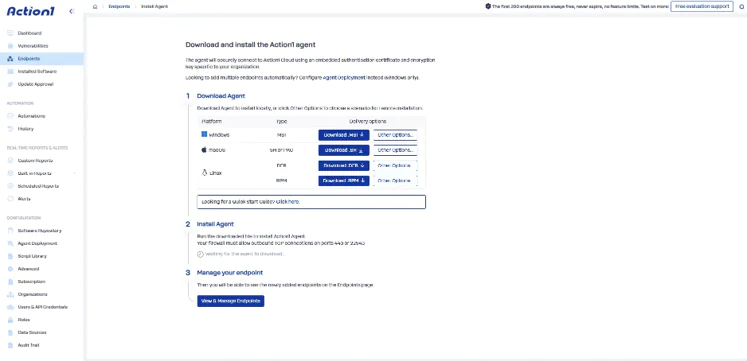
Endpoints connect outbound over port 443 to the Action1 cloud, so you don’t need a VPN, appliance, on-premises server, or cache server. Active Directory integration automates agent deployment to domains. As your endpoint count grows, you can extend management coverage without purchasing new hardware or additional infrastructure.
Scoped Ownership with Role-Based Access and Organizations
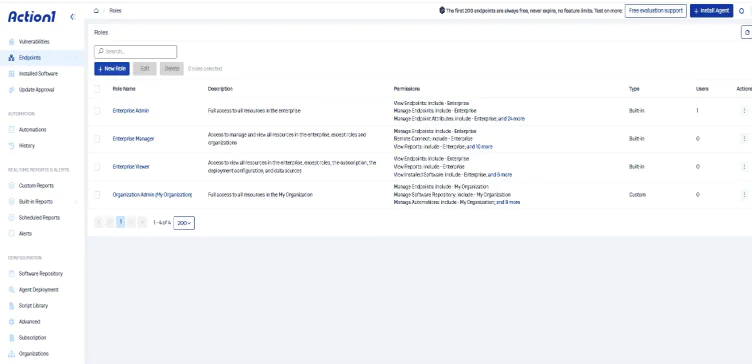
Custom roles let you restrict permissions to specific organizations, endpoint groups, scripts, reports, and automations. Separate organizations isolate each business unit or client with its own endpoints, configurations, and approval workflows. Together, these controls enforce least privilege and prevent administrative changes from spilling across tenant boundaries.
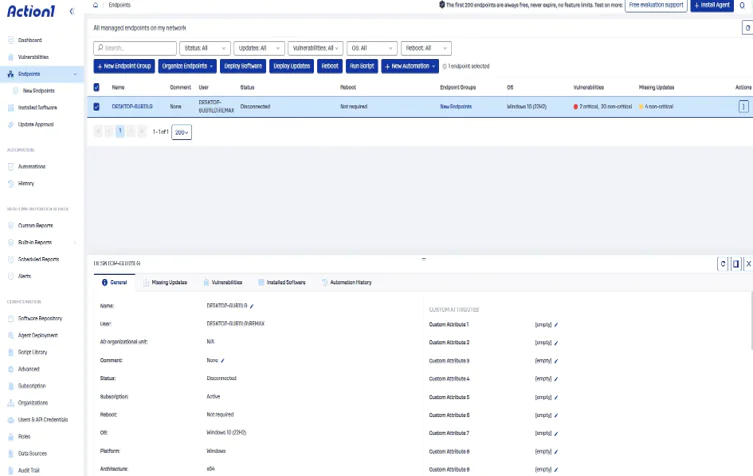
Real-time Asset Inventory and Alerts
Action1 gives you real-time visibility into every endpoint, installed application, and software version. Dynamic groups auto update their membership based on operating system, Active Directory organizational unit, installed software, and custom attributes. Meanwhile, real-time alerts flag unauthorized software changes and notify you when an endpoint stays offline past a set threshold.
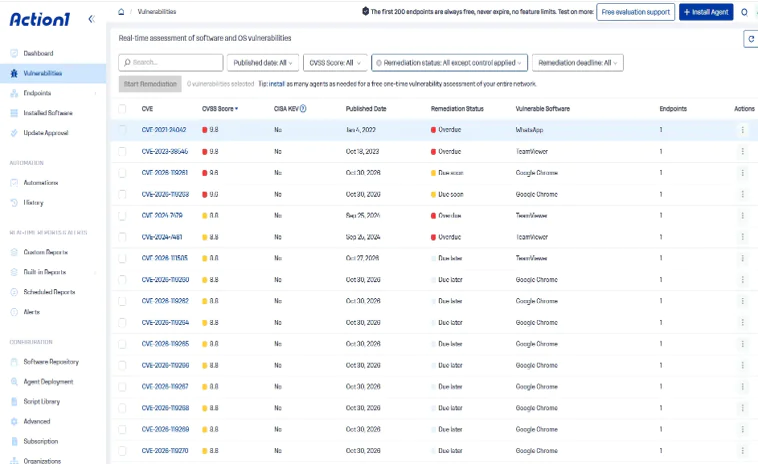
Vulnerability Identification with Exploitation Context
Action1 identifies vulnerable operating system and software versions on Windows and macOS endpoints. Findings include CVE identifiers, CVSS scores, CISA KEV status, and information about vulnerabilities used in known ransomware campaigns. This context helps teams prioritize findings based on factors such as technical severity, real-world exploitation risk, and business impact.
Multiple Vulnerability Data Sources
Action1 draws vulnerability information from multiple sources, including VulnCheck NVD++, NIST National Vulnerability Database (NVD), CISA KEV, Microsoft Security Response Center (MSRC), and vendor release notes. Cross-referencing these feeds gives teams more complete, timely vulnerability data than relying on NIST NVD alone.
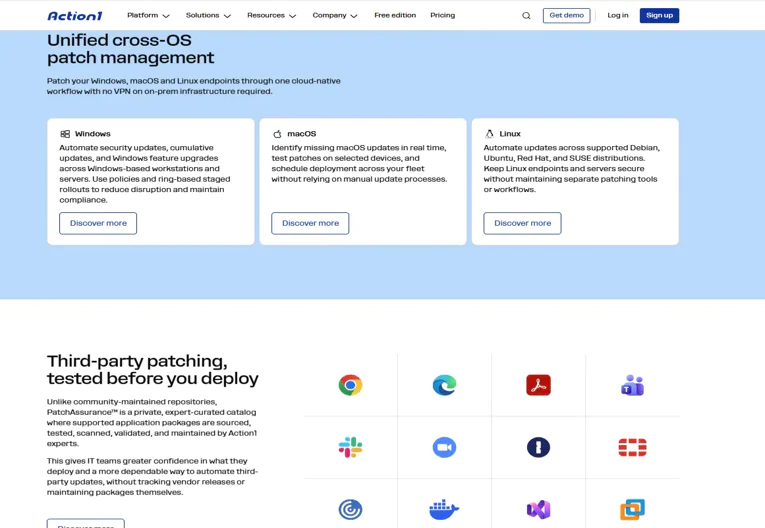
Cross-OS and Third-Party Patching in One Workflow
Action1 supports operating system patching for Windows, macOS, and Linux, along with third-party application patching on Windows and macOS. Teams can manage supported OS updates, third-party application updates, and custom software deployments through the same workflow. However, the underlying package delivery varies by platform, such as curated vendor repositories for Windows and macOS apps versus native distribution repositories on Linux.
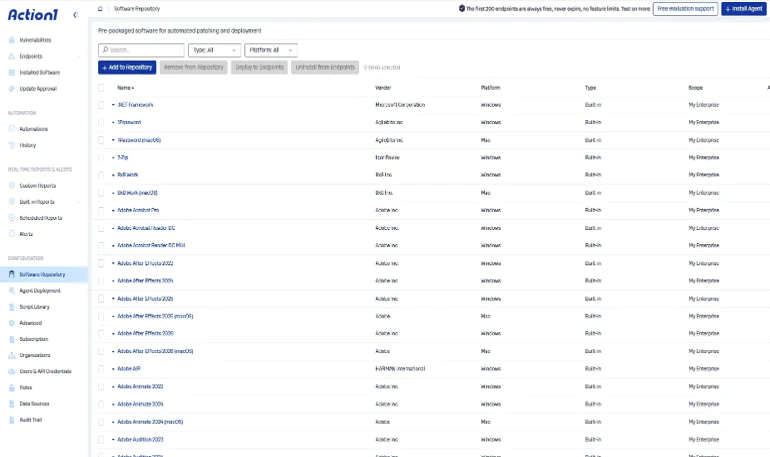
Private Software Repository and P2P Distribution
Action1 maintains its own secure, tested repository for Windows and macOS third-party software updates rather than relying on community-maintained repositories such as Chocolatey or WinGet. Its peer-to-peer (P2P) distribution helps deliver large updates to endpoints on the same local network, reducing WAN bandwidth usage without requiring on-premises cache servers or distribution points.
Autonomous Patching with Flexible Automation, Scheduling, and Offline Catch-Up
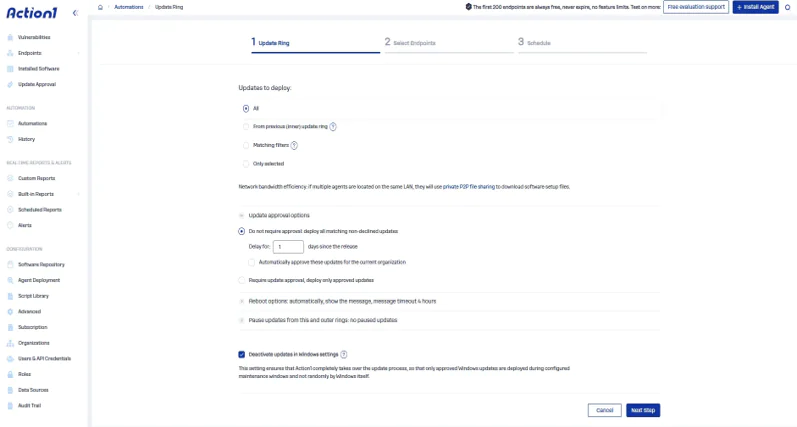
Action1 supports hands-off patching while giving IT teams control over approvals, deployment timing, and rollout conditions. Capabilities include:
- Update rings: Move patches through inner and outer deployment rings based on success metrics. Qualifying patches advance automatically.
- Automatic and manual approvals: Automatically approve eligible updates after an optional delay, or require manual approval to protect critical systems.
- Flexible automation: Run automations immediately, on recurring schedules, or according to each endpoint’s local time.
- Offline catch-up: Endpoints that miss a deployment because they are offline can receive the update automatically after reconnecting, subject to the catch-up deadline you configure.
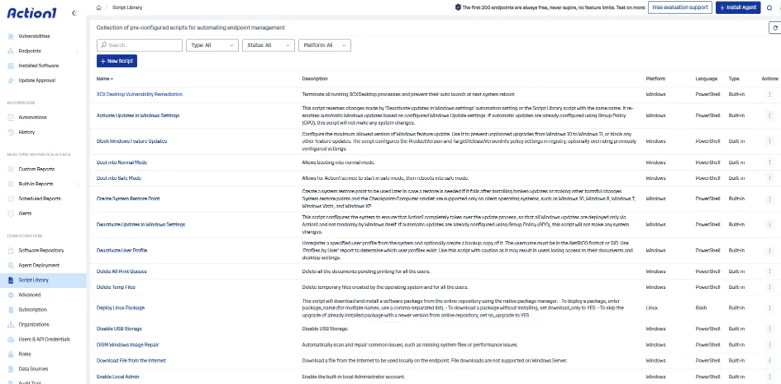
Remediation Beyond Patching
Not every vulnerability can be resolved by installing a patch. Action1 supports additional remediation actions, including bulk removal of unsupported or legacy software, with options to target specific versions and per-user applications. Built-in scripts can enable the firewall or disable USB access, while custom PowerShell, CMD, and Bash scripts can apply configuration fixes. Teams can also document compensating controls centrally when a vulnerability cannot be patched.
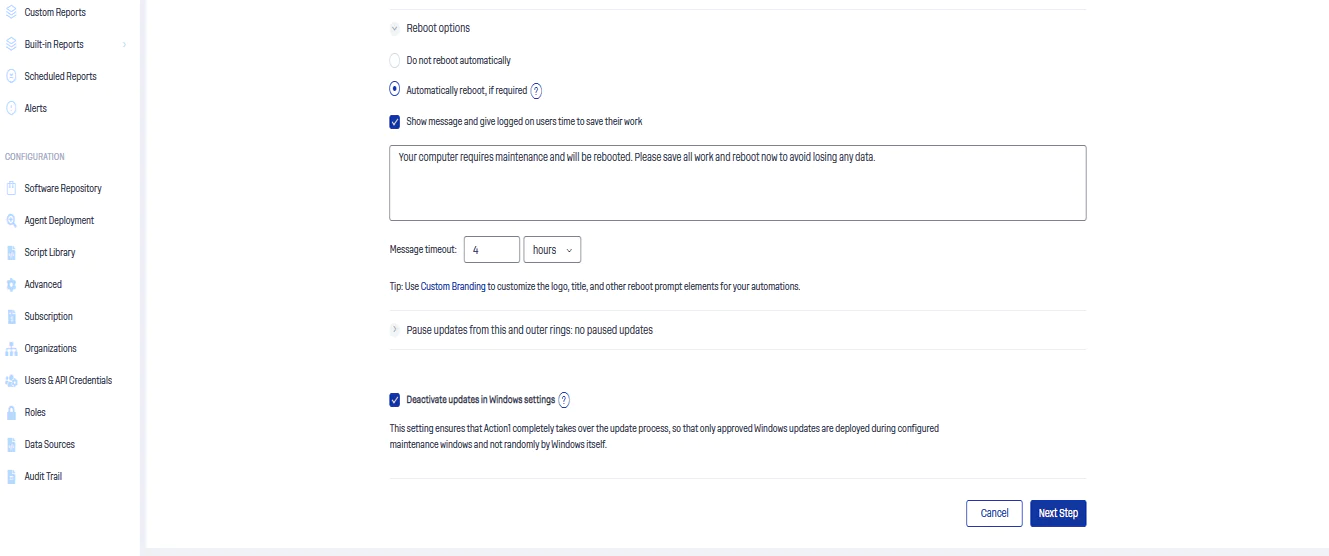
Reboot Control
Some patches do not take effect until an endpoint restarts. Action1 provides customizable reboot prompts and postponement deadlines so IT teams can give users advance notice while ensuring required restarts happen.
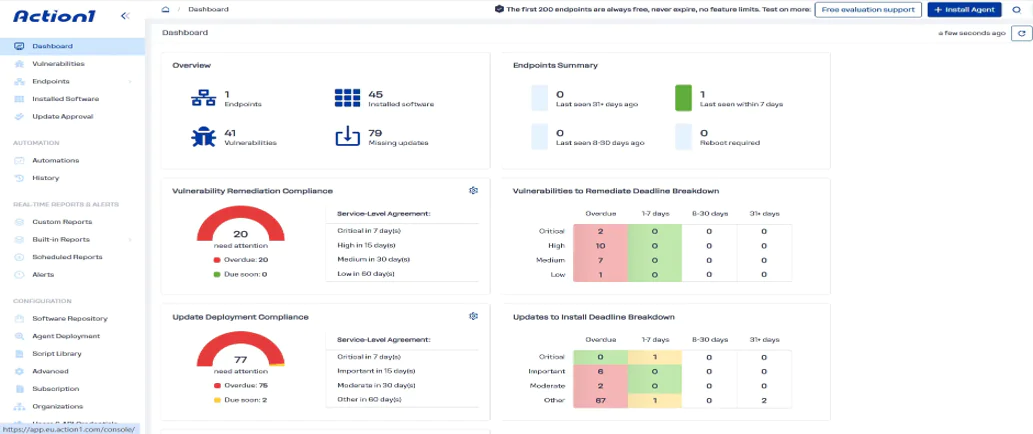
SLA Dashboards and Audit-Ready Reporting
Action1 helps teams track remediation progress and retain evidence through:
- Dashboards track active vulnerabilities and patch compliance against SLAs.
- You can clone and modify built-in reports or create reports using PowerShell output. Schedule reports by email or export them to CSV.
- Reports combine live data with cached data from offline endpoints.
- An audit trail records every action, and REST API access feeds information into SIEM or XDR tools.
Support for the Frameworks Covered in This Article
Action1 supports the operational activities that contribute to vulnerability and patch management requirements in CIS Controls, PCI DSS, HIPAA, and NIST guidance. For example, it supports CIS Controls v8.1 Control 7 through vulnerability remediation workflows and automated operating system patch management, including Safeguards 7.2 and 7.3. Its endpoint and software inventory capabilities also support Control 1 (Enterprise Assets) and Control 2 (Software Assets). However, Action1 does not replace an organization’s broader compliance program or guarantee compliance with any framework. Organizations must also address applicable requirements for governance, risk assessment, access control, incident response, and other areas outside endpoint management.
Security and Certifications of Action1 Itself
Action1 also provides security controls and third-party assurance information relevant to organizations evaluating it:
- Action1 is certified for SOC 2 Type II, ISO/IEC 27001:2022, and TX-RAMP.
- It’s listed in the CSA STAR Registry (Level 1) and has signed CISA’s Secure by Design Pledge.
- Access is protected by app-based MFA, SSO, and IP restrictions, and agents communicate over TLS 1.2 with AES-256.
- Penetration testing and a bug bounty program run through HackerOne.
- Customers can keep their data in North America, Europe, the United Kingdom, or Australia. That helps organizations in government, critical infrastructure, and other regulated industries meet local data residency requirements.
Keep track of your vulnerability management progress with Action1. Monitor patch compliance, track remediation, and get audit-ready reports. Sign up free for up to 200 endpoints, fully featured, or schedule a demo to see how it works.