




If you are in a hurry – here is a TL;DR & Summary of main key points
- OT patching secures industrial systems without disrupting uptime
- Harder than IT: legacy assets, 24/7 ops, limited visibility
- Prioritize using risk (not just CVSS): asset criticality + threats
- Follow a structured workflow: inventory → assess → patch → document
- Use phased deployment, testing, and rollback to avoid disruption
- Maintain documentation for compliance (NERC CIP, ISA/IEC, etc.)
What is OT Patch Management?
OT patch management is the process of identifying, sourcing, testing, deploying, and documenting software updates (patches) within OT and industrial control system (ICS) environments. It may sound straightforward, but in practice, it requires specialized equipment, skilled resources, and strict adherence to regulations and safety standards.
Why OT patch management matters?
Originally, OT environments were designed with availability and reliability in mind, not cybersecurity. These systems were built to run continuously for decades. While this longevity is a strength, it also means that security vulnerabilities can linger far longer than desired.
The stakes are high. When an unpatched vulnerability in an OT system gets exploited, consequences can include data loss, production shutdowns, equipment damage, safety incidents, and disruptions to critical services that communities depend on. Delayed or missing patches not only increase exposure to cyber threats, but they also create compliance risks.
Effective patch management shrinks how long systems stay at risk, keeps operations running smoothly, and helps organizations comply with regulatory frameworks.
Core Objectives of OT Patch Management
OT patch management aims to:
- Reduce cybersecurity risk by remediating vulnerabilities before attackers can exploit them.
- Maintain operational continuity by applying updates that fix bugs and improve performance.
- Minimize downtime and disruption through scheduled and phased deployment.
- Support regulatory and audit readiness through documentation and change management processes.
OT Vulnerability Management vs. OT Patch Management
These two terms represent distinct yet complementary activities.
What is OT vulnerability management?
OT vulnerability management is the process of identifying, assessing, mitigating, and continuously monitoring weaknesses in your industrial systems, such as hardware and software that control turbines, pumps, and robotic arms on a factory floor. The goal is to know what vulnerabilities exist, understand their impact on your specific environment, and make informed decisions about how to address them.
For effective vulnerability management, you need to know exactly what computing assets you have, their configuration details, and what vulnerabilities are associated with those configurations, considering factors like asset criticality, exploitability, and network exposure.
What is OT patch management?
OT Patch management is a subset of vulnerability management. It mainly focuses on the remediation of vulnerabilities through controlled patching processes. This includes sourcing vendor-approved updates, testing them for compatibility, obtaining approvals, deploying them to the right assets, and documenting the entire process. If vulnerability management tells you what needs fixing, patch management is how you fix it.
How vulnerability management and patch management differ?
Vulnerability management and patch management serve different purposes within an OT security program. Vulnerability management spans the full lifecycle of a weakness, from discovery through risk evaluation to prioritization and mitigation. Patch management is more execution-focused. It picks up where vulnerability assessment leaves off and drives the actual remediation.
How vulnerability management informs patching decisions?
Asset visibility, vulnerability intelligence, and risk assessment all determine which patches should be prioritized and when. A vulnerability management program tells you which assets are affected, how severe the exposure is, and which patches should be prioritized. Without that intelligence, patch deployment becomes a reactive, inconsistent exercise that may fail to address the most critical risks to operational continuity.
Why OT Patch Management is more Difficult than IT Patch Management?
Ask any OT security practitioner what makes their job hard, and patching will come up almost immediately. Here are the reasons:
Continuous Uptime Requirements
Many OT systems operate around the clock, every day of the year. Power plants, water treatment facilities, and oil and gas pipelines are not environments where you can simply push a patch on a Tuesday afternoon and reboot when convenient. Downtime windows are rare and limited to scheduled maintenance periods that may occur only once or twice a year. Even a brief, unplanned interruption can have serious operational consequences.
Legacy systems and unsupported assets
In OT environments, it is not unusual to find equipment that has been running continuously for 15 or 20 years, often on operating systems that the vendor no longer supports. In some cases, patches are not available as the vendor has ceased all support. Organizations have to rely on compensating controls and alternative mitigations to manage the risk.
Heterogeneous and specialized environments
An OT environment is not a homogeneous fleet of similar devices. It is a collection of PLCs, distributed control systems (DCS), SCADA software, relays, Windows, Unix, Linux, and non-Windows assets. They come from dozens of different vendors, each with their own patch cycles, approval processes, and deployment requirements. Managing all of that coherently is genuinely hard.
Limited visibility
Traditional IT monitoring tools cannot automatically inventory or assess OT assets without risking disruption to those very assets. The result is that many organizations do not have complete asset and software inventories, which makes it impossible to know what needs patching.
Specialized expertise requirements
Reviewing, approving, and deploying patches in an OT environment is not a task for a general IT administrator. It requires a working understanding of PLCs, DCS architecture, SCADA systems, and the operational risks of applying updates to equipment that directly controls physical processes.
Testing constraints
In IT, you test patches in a staging environment before rolling them out to production. In OT, that staging environment does not exist. Replicating an industrial control system in a test lab is expensive and complex, and many organizations simply cannot do it. This forces teams to deploy patches based on calculated assumptions rather than verified results.
Deployment complexity
Diverse devices across dispersed sites require different deployment methods and schedules. Some assets can be patched remotely and automatically; others require a trained engineer to be physically present. Coordinating all of that, while respecting operational schedules and minimizing risk, results in a huge logistical burden.
Compliance and documentation burden
OT teams need to document every step of the patch process, including vulnerability assessments, approvals, change management records, and deployment results. For organizations subject to NERC CIP or ISA/IEC 62443, this documentation is a compliance requirement.
Common OT Patch Management Challenges
Even organizations with dedicated OT security teams face patching challenges, such as those discussed below.
| Challenges | Description |
| Visibility Gaps |
With traditional IT tools, it is almost impossible to maintain an automatic asset inventory and monitoring of OT systems. As a result, organizations have incomplete or outdated records of what devices they have, what software versions are running, and what patch levels are current. That gap in visibility is where risk accumulates.
|
|
Patch overload and fragmented patch sources
|
Tracking and sourcing patches across a wide range of specialized systems, applications, and vendors is exhausting. Different vendors publish updates on different schedules, through different portals, and with varying levels of detail. Security teams spend time just trying to understand what patches exist before they even get to the question of which ones to apply.
|
|
Difficulty matching patches to the correct assets
|
Knowing that a patch exists is one thing; knowing which of your specific devices require it is another. The manual process of mapping vulnerability bulletins to the right assets, based on operating system, firmware version, and configuration, is time-consuming and error-prone.
|
|
Manual review of multiple vendor portals |
Many Original Equipment Manufacturers (OEMs) publish vulnerability information and patch releases exclusively on their own customer portals. Security teams must regularly check multiple vendor sites, which creates a manual overhead and increases the risk of missing something important.
|
|
Risk of operational disruption from testing or deployment |
In OT environments, patches may negatively affect safety, reliability, and business continuity if they are not applied correctly. That risk discourages patching, especially for critical infrastructure facilities that operate 24/7. Even scheduling downtime for patching remains a challenge. According to TXOne Networks’ 2024 Annual OT/ICS Cybersecurity Report, an alarming 85% of organizations do not conduct regular patching in their OT environments, primarily because of fears around equipment downtime and operational disruption.
|
|
Lack of automation across the OT estate |
Many OT patching processes are still manual. Without automation, it is almost unmanageable to assess, approve, deploy, and document patches across hundreds or thousands of assets.
|
|
Limited staff time and expertise |
It requires extensive manual effort to stay current with security patches, and organizations lack the dedicated headcount to keep up. Moreover, you need people who deeply understand OT environments like SCADA and DCS, and finding that expertise is a major challenge.
|
|
Regulatory pressure and audit readiness demands |
NERC CIP requires that security-related patches be assessed within 35 days of their release. Industry-specific standards like ISA/IEC 62443 focus on security for industrial automation and control systems. Other frameworks impose their own timeline and documentation requirements. Meeting these obligations while also managing day-to-day operational responsibilities can stress already stretched teams.
|
OT Patch Management End-to-End Workflows
Patch management in an OT environment is a repeatable, six-step workflow that enables organizations to balance security with operational discipline.
Step 1: Establish an OT asset inventory baseline
An effective OT security program starts with visibility. You need to know exactly what assets you have, where they are located, what software and firmware versions they are running, and what their current patch levels are. Without that foundation, nothing else works.
This is harder than it sounds. OT environments are made up of disparate assets, such as PLCs, DCS controllers, SCADA servers, historians, engineering workstations, and relays. Inventorying them using conventional IT tools may cause disruption. You should use automated collection tools for supported devices and manual approaches for everything else for comprehensive visibility.
An accurate, continuously updated asset inventory reduces the attack surface. Every asset you can see is an asset you can monitor and protect. Every asset that falls through the cracks is invisible until something goes wrong.
Step 2: Identify vulnerabilities and available patches
With a solid asset inventory in place, the next step is continuous vulnerability monitoring. The goal is to understand which vulnerabilities affect your specific environment and which patches or compensating controls are available to address them.
There are three primary sources of vulnerability information that OT teams need to monitor, as discussed in the Sources of Vulnerability Information section. These are public vulnerability databases, ICS-specific advisories from sources like ICS-CERT, OEM, and vendor-specific portals. No single source provides a complete picture. Teams must continuously monitor all three sources to manage timely updates and combat emerging threats.
Step 3: Match patches to the right assets
Once you know what patches exist, you need to determine which asset requires which specific updates. This sounds simple, but the reality is quite complex.
Asset characteristics matter enormously here. Consider this:
- The same vulnerability may affect some firmware versions of a device but not others.
- A patch that addresses a Windows Server vulnerability may apply to your engineering workstations but not your PLCs.
The solution is to filter assets by operating system, firmware version, criticality, NERC CIP classification, or any other relevant attribute. This allows you to identify the specific devices that need a given update and to ignore the ones that do not.
Doing this manually is extremely time-consuming. Rather, automate the process for mapping vulnerabilities to assets based on their specific characteristics. This dramatically shortens the time it takes to identify in-scope systems and reduces the risk of missed or misapplied patches.
Step 4: Review, approve, and manage patches
Before a patch goes anywhere near a production system, it needs to be reviewed for relevance, validated against vendor approval, and formally authorized through a change management process. This is best managed by establishing patch baselines, which is a living, organized record of which patches are approved, which are pending review, and which have been marked as inapplicable or deferred. These baselines:
- Make it easier to onboard new assets, since the approved patch state for a given device type is already defined.
- Provide accountability, auditability, and transparency that both security and compliance demand.
Organizations should centralize the baselining and approval process rather than managing it through disconnected tools and spreadsheets. This ensures that every deployment is authorized, compatible, and fully documented for the next audit.
Step 5: Test and deploy patches
It is almost impossible to build test environments that mirror production. Yet organizations can still conduct pre-deployment patch testing in controlled environments. This helps teams identify compatibility conflicts or functional errors that can cause disruptions.
In production environments, phased deployment remains the recommended approach. Start with low-risk assets, monitor for unexpected behavior, and expand the rollout only after successful validation. Use automated and manual deployment options where applicable.
- For Windows, Unix, and Linux systems that support programmatic deployment, patches can be pushed from a central console on a controlled schedule.
- For specialized or legacy devices that do not support automated deployment, OT-experienced engineers may have to work on-site.
Rollback capability is fundamental. If a patch causes unexpected behavior, you should be able to revert it quickly to prevent a serious operational incident.
Step 6: Document changes and maintain compliance
Every step of the patching process, including vulnerability assessment, approval decision, deployment action, and post-deployment verification, must be documented to support audit review. This means:
- Capturing the pre-patch and post-patch state of systems.
- Running baseline reports after applying patches to confirm that everything was applied correctly.
- Maintaining a timestamped record of all changes.
For organizations subject to NERC CIP, NIST SP 800-40, or ISA/IEC 62443, this documentation is mandatory.
Sources of Vulnerability Information
OT teams can consult the following sources for vulnerability information:
| Source | Description |
| Public vulnerability databases | The NIST National Vulnerability Database (NVD) is the primary public repository for known vulnerabilities, drawing from MITRE’s Common Vulnerabilities and Exposures (CVE) list. It provides standardized severity scores and detailed technical descriptions that help teams understand the nature and impact of each vulnerability. |
| ICS-specific advisories and alerts | ICS-CERT, operated under the Cybersecurity and Infrastructure Security Agency (CISA), publishes timely alerts and advisories specifically focused on vulnerabilities, security issues, and exploits affecting industrial control systems. |
| OEM and vendor-specific sources | Many manufacturers publish vulnerability and patch information exclusively through their own customer portals, meaning it never appears in public databases. For OT teams, someone needs to periodically check each relevant vendor portal to ensure nothing has been missed. |
Relying on any single source is a risk. Public databases may lag behind vendor disclosures. Vendor portals may not publish to public feeds. ICS-CERT advisories cover a specific segment of the threat landscape. Only by monitoring public, vendor, and threat intelligence sources simultaneously can OT teams stay aware and patch effectively.
Compliance and Standards Landscape
Multiple frameworks and standards impose specific requirements on how organizations identify, assess, and remediate vulnerabilities in industrial environments.
| Standard / Framework | Focus Area | Requirement & Relevance |
| NERC CIP-007 | System Security Management | Requires an enforceable patch management process for BES (Bulk Electric System) Cyber Assets, including evaluating security patches within 35 days of release and installing applicable patches within specific timelines. |
| NERC CIP-010 | Configuration Change Management and Vulnerability Assessments | Requires baselining, change monitoring, and periodic vulnerability assessments to ensure that patches or updates don’t compromise system stability. |
| NIST SP 800-40 Rev. 4 | Guide to Enterprise Patch Management | Provides the modern framework for planning and orchestrating patch management across diverse enterprise architectures. |
| ISA/IEC TR 62443-2-3 | Patch Management in IACS | Defines guidance for asset owners and product suppliers on the exchange of patch information and the secure deployment of patches in industrial automation and control system environments. |
| ISA/IEC 62443 | Industrial Automation & Control Systems (IACS) Security | The comprehensive industrial security standard series that establishes the global “Defense-in-Depth” framework for OT security programs globally. |
| ISO 27001 | Information Security Management | Requires documented information security controls, including change management and audit trails. |
| GDPR | Data Protection & Privacy | Applies where OT systems process personal data, adding data protection obligations to the compliance picture. If an OT breach leaks personal data due to unpatched systems, it’s a violation. |
Several common threads emerge across these frameworks: assess patches within defined timelines, maintain clear records of vulnerabilities and changes, and ensure documentation is audit-ready.
Meeting these expectations isn’t just about avoiding penalties. When organizations take compliance seriously, they build a stronger security posture overall. The need to stay audit-ready pushes them to build the visibility, processes, and documentation that good security depends on.
Operation-Centric / Context-Aware Prioritization
A common misconception in OT security is the idea that vulnerability severity scores alone can tell you what to patch first. They cannot. Acting on CVSS alone without operational context can lead to wasted effort and unnecessary risk from chasing vulnerabilities that pose little threat to your specific OT environment.
Limits of severity-only prioritization
The Common Vulnerability Scoring System (CVSS) provides a standardized measure of vulnerability severity, and it does that reasonably well. But the problem is, CVSS scores are calculated based on the general characteristics of the vulnerability, not on your specific environment. A critical CVSS score on a vulnerability that affects a component that is already mitigated in your environment by existing controls does not represent the same level of risk as the same score on a vulnerability that is actively exploitable in your specific configuration. Therefore, do not treat every high CVSS score as equally urgent.
Using CVSS in OT environments
CVSS provides three metric groups that offer a comprehensive risk profile picture when used together.
- Base metrics evaluate the intrinsic characteristics of the vulnerability, such as, attack vector, privileges required, and potential impact, that remain constant over time and across environments.
- Temporal metrics account for factors that change over time, such as whether exploit code is publicly available and whether a patch has been released.
- Environmental metrics allow organizations to adjust scores based on their specific infrastructure, accounting for security controls already in place and the relative importance of affected assets.
By using all three metric groups, particularly the environmental scoring, CVSS can help assess your organization’s actual risk exposure.
CVSS scores can be used to prioritize patching. Organizations can define their own response timelines based on severity, risk, and operational constraints, similar to the following:
| Vulnerability Severity | CVSS Score | Recommended Patch Timeline |
| Critical | 9.0 – 10.0 | Emergency: Immediate (within 24–48 hours) |
| High | 7.0 – 8.9 | Urgent: Within 7 to 14 days |
| Medium | 4.0 – 6.9 | Routine: Within 30 to 60 days |
| Low | 0.0 – 3.9 | Planned: Within 90 days or during the next scheduled maintenance window |
Adding threat intelligence
Threat intelligence answers a question CVSS alone can’t: whether a vulnerability is actually being exploited in the real world. A medium-scored flaw that’s actively used in ransomware campaigns against industrial systems deserves faster attention than a higher-score vulnerability with no known exploitation.
By combining CVSS with threat intelligence, such as CISA’s Known Exploited Vulnerabilities (KEV) catalog, you can prioritize real, active threats instead of theoretical risk. It also helps you focus on the vulnerabilities most likely to be exploited for operational disruption.
Adding business and operational context
Even with CVSS and threat intelligence, not all vulnerabilities are equal. The same vulnerability on an admin workstation carries a very different risk profile than the same vulnerability affecting a controller that manages a safety-critical production process. What the asset does and what happens if it fails matters just as much as the score.
Business and operational context fills that gap. You should prioritize assets that are critical to processes or safety, while less critical systems can wait. Existing protection controls also matter. Well-isolated and monitored systems carry less real risk, while exposed or legacy devices may need faster attention even for moderate issues.
Priority scoring and focused remediation
Mature OT security programs combine CVSS, threat intelligence, asset criticality, operational context, and existing controls to calculate a more realistic risk score for each vulnerability. This approach is sometimes called vulnerability situational awareness or risk-based vulnerability management.
The result is a shift from overwhelming patch lists to focused action, enabling you to reduce large vulnerability lists to the items that pose the greatest real risk. This supports smarter remediation and mitigation decisions, reduces noise, promotes efficient use of resources, and leads to stronger security outcomes.
Defend Without Disruption: Maintaining Uptime During Patching
A major challenge in OT patch management is to strike a balance between security and operational continuity.
Why uptime requirements make OT patching difficult?
Unlike a standard IT office environment, you can’t just hit “restart” on a production line. Many OT systems, such as those that power critical infrastructure, run 24/7 and cannot tolerate interruptions during normal operations. This leaves teams walking a tightrope: security updates are necessary, but they must be planned around operational schedules to avoid costly, unplanned downtime.
Testing patches without affecting production
Organizations should invest in building a dedicated test lab that mirrors their production line. If that’s not possible, the next best thing is a sandbox or low-scale version of your setup where you can break things without consequences. You must also review vendor documentation to catch known compatibility issues before they reach the plant floor.
Phased rollouts and low-risk asset validation
Start by deploying patches to non-critical or low-risk assets. This allows you to validate patch behavior in a production-representative environment before touching mission-critical systems. If unexpected behavior occurs, you can investigate and resolve it without incurring a major operational incident. Only move forward once the results give a green signal.
Rollback planning and operational safeguards
In a perfect world, every patch works. In the real world, you need a Plan B. You must have a documented rollback strategy to restore the previous state immediately if things go sideways. Additional controls include backups, reboot triggers, and retry settings to ensure that even if an update fails, the system stays operational.
Deployment Best Practices for OT Environments
Here are some best practices for patch deployment.
- Use controlled circumstances for automation: Automated patch deployment is most appropriate for well-understood assets in controlled conditions where the risk profile is known. It is not appropriate for first-time patches on critical systems, for devices with unusual configurations, or in situations where the consequences of an unexpected behavior could be severe.
- Roll out in phases: As discussed earlier, phased deployment starts with lower-risk assets, validates the results, and expands coverage incrementally.
- Include operational safeguards: Rollback capabilities, reboot controls, on-device messaging, and retry settings should be standard elements of any OT deployment process as they provide a safety net when things go wrong.
- Use expert support when needed: Some assets, such as legacy devices, safety systems, and specialized controllers, require hands-on expertise. Engage OT-experienced engineers for on-site deployment of patches on sensitive or unsupported devices to reduce rollout risk
How to Build an Effective OT Patch Management Program?
To build an effective OT patch management program, you need to get a few foundational elements right, as also discussed in the section.
Automated asset inventory collection
The program starts with comprehensive asset visibility. Automated inventory collection ensures that the asset database is accurate, current, and complete. This includes capturing the device type, location, configuration details, software version, firmware version, and current patch level of an asset.
Real-time vulnerability monitoring
Effective programs must monitor vulnerability intelligence sources continuously, not periodically. Real-time monitoring means that as new CVEs are published, as ICS-CERT advisories are issued, and as OEM portals are updated, the relevant information is automatically correlated against the asset inventory. This process quickly identifies which assets are affected and what response is required.
Vendor-approved patch visibility
Many OT assets are covered under vendor support agreements that specify which patches have been tested and approved for an asset. Deploying unapproved patches can void support contracts, cause compatibility issues, or create operational problems. An effective program monitors vendor-approved patch availability across the asset base, ensuring that deployment decisions are based on what the equipment manufacturer has validated.
Patch-to-asset matching
Patches should be automatically matched to the specific assets that require them based on device type, operating system, firmware version, and other relevant attributes. This dramatically reduces the manual effort and eliminates human errors. This capability is what makes it possible to manage patching at scale across large, heterogeneous OT environments.
Patch baselines and approval workflows
Patch baselines, defining which patches are approved, pending, inapplicable, or deferred, help in controlled, auditable patch management. Approval workflows should route patch review requests to the right stakeholders, capture decisions with context, and feed into deployment scheduling. These baselines also support ongoing compliance monitoring. At any given time, you can determine whether its assets are at the approved patch state or have drifted from baseline.
Programmatic deployment for supported systems
For Windows, Unix, and Linux systems that support automated deployment, it’s best to push patches programmatically from a central console, on a controlled schedule, and to specified asset groups. This saves time and reduces the inconsistencies that come with manual deployment processes. Combine this with phased rollout controls so that deployment can be staged and monitored.
Rollback and deployment controls
Deployment controls should include automatic rollback on failure, configurable reboot scheduling, on-device status messaging, and retry configuration. This provides a safety net and makes patching a manageable routine activity rather than a high-stakes exercise.
Baseline reporting and audit trail generation
Automated baseline reports that capture pre- and post-patch system states, combined with an audit trail of all deployment actions and approval decisions, address the compliance documentation burden. By generating compliance-ready reports on demand rather than assembling them manually before each audit, you can reduce cost, effort, and risk.
Integration of threat intelligence and business context
Your program must incorporate threat intelligence and operational context into the vulnerability management workflow. This ensures that prioritization is informed by current threat activity and asset criticality rather than just CVSS scores.
Alignment of people, process, and technology
A strong OT patching programs combines three elements: skilled personnel who understand OT environments, documented and repeatable processes that ensure consistency, and purpose-built tools that automate asset correlation, vulnerability mapping, and patch tracking.
Benefits of a Mature OT Patch Management Program
A solid OT patch management program does not just keep systems updated; it cultivates a mature risk-aware approach to maintaining security and reliability across industrial environments. Benefits include:
- Reduced cyber risk: Timely and risk-based patching reduces exposure to known vulnerabilities, which limits opportunities for attackers to exploit them.
- Shorter vulnerability windows: A documented and consistent patching process ensures that vulnerabilities are identified, assessed, and addressed faster. This reduces the time systems remain exposed.
- Improved operational continuity: Planned, controlled, and phased patching minimizes the risk of unplanned disruption while security updates are applied.
- Less manual work and greater accuracy: By automating inventory, patch-to-asset matching, and documentation tasks, you can reduce repetitive manual effort and lower human error. Standardized workflows can bring consistency to patch tracking and deployment.
- Better prioritization of remediation efforts: Context-aware scoring and risk-based prioritization focus resources on vulnerabilities that truly matter, rather than relying solely on severity scores.
- Stronger compliance posture: A mature patch management program aligns with security frameworks like NIST and ISA/IEC, while helping meet regulatory requirements such as NERC CIP through documented, auditable processes.
- Improved audit readiness: Centralized documentation of vulnerabilities, approvals, and patch actions makes it easier to demonstrate compliance. Automated reporting and baseline management also allow teams to product compliance documentation quickly during audits.
- Scalable support across complex OT environments: A mature program can be applied to diverse and distributed OT assets, supporting growth without losing control or visibility.
How can Action1 help with Patch Management?
Action1 enables organizations to bring structure, automation, and scale to their patch management programs stretched across diverse environments. From automated asset discovery and real-time vulnerability monitoring to controlled deployment workflows and compliance-ready reporting, it supports the full end-to-end patch management lifecycle. Here is how Action1 addresses the challenges of patch management.
Unified Cross-Platform and Third-Party Patching
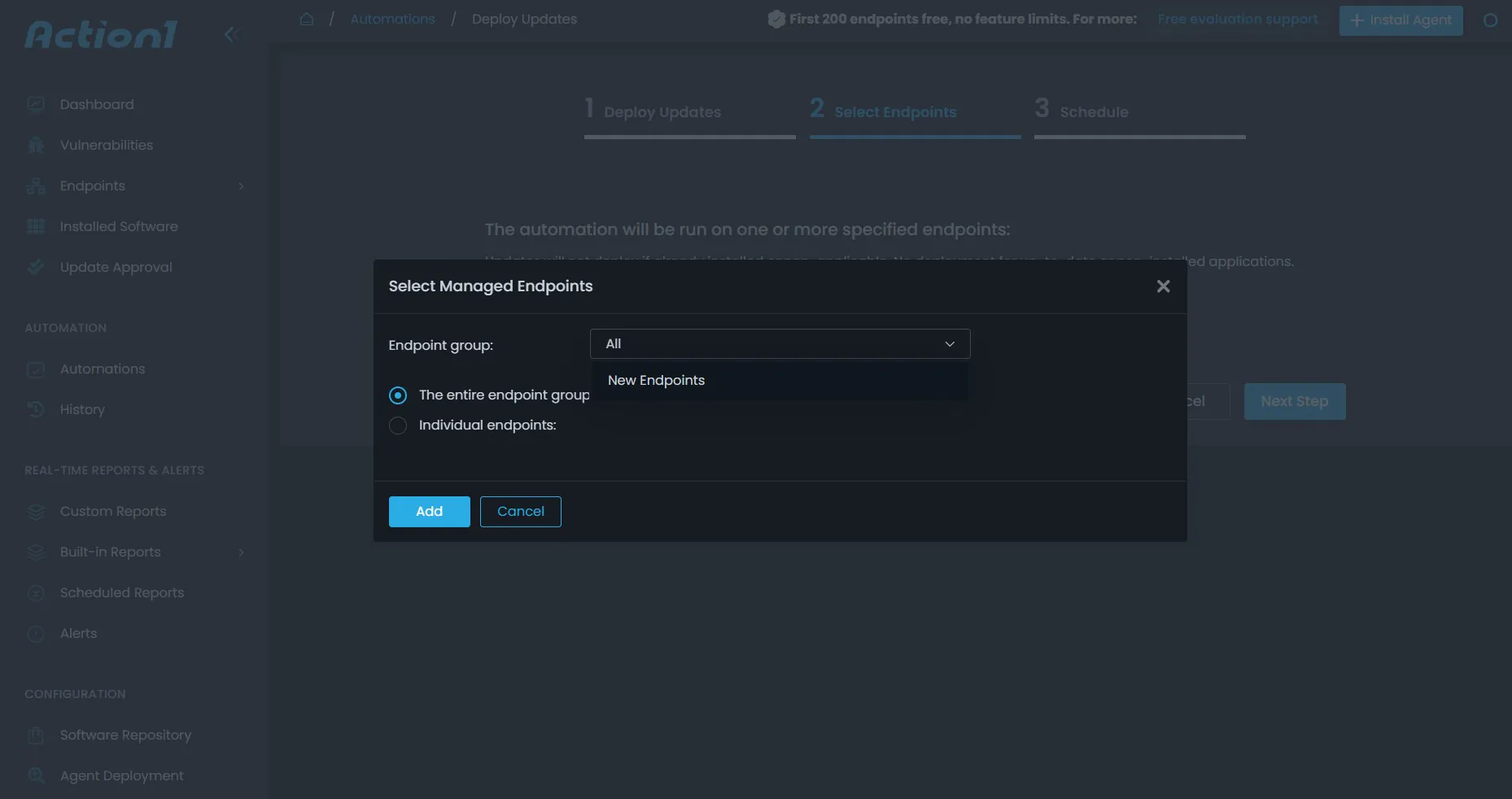
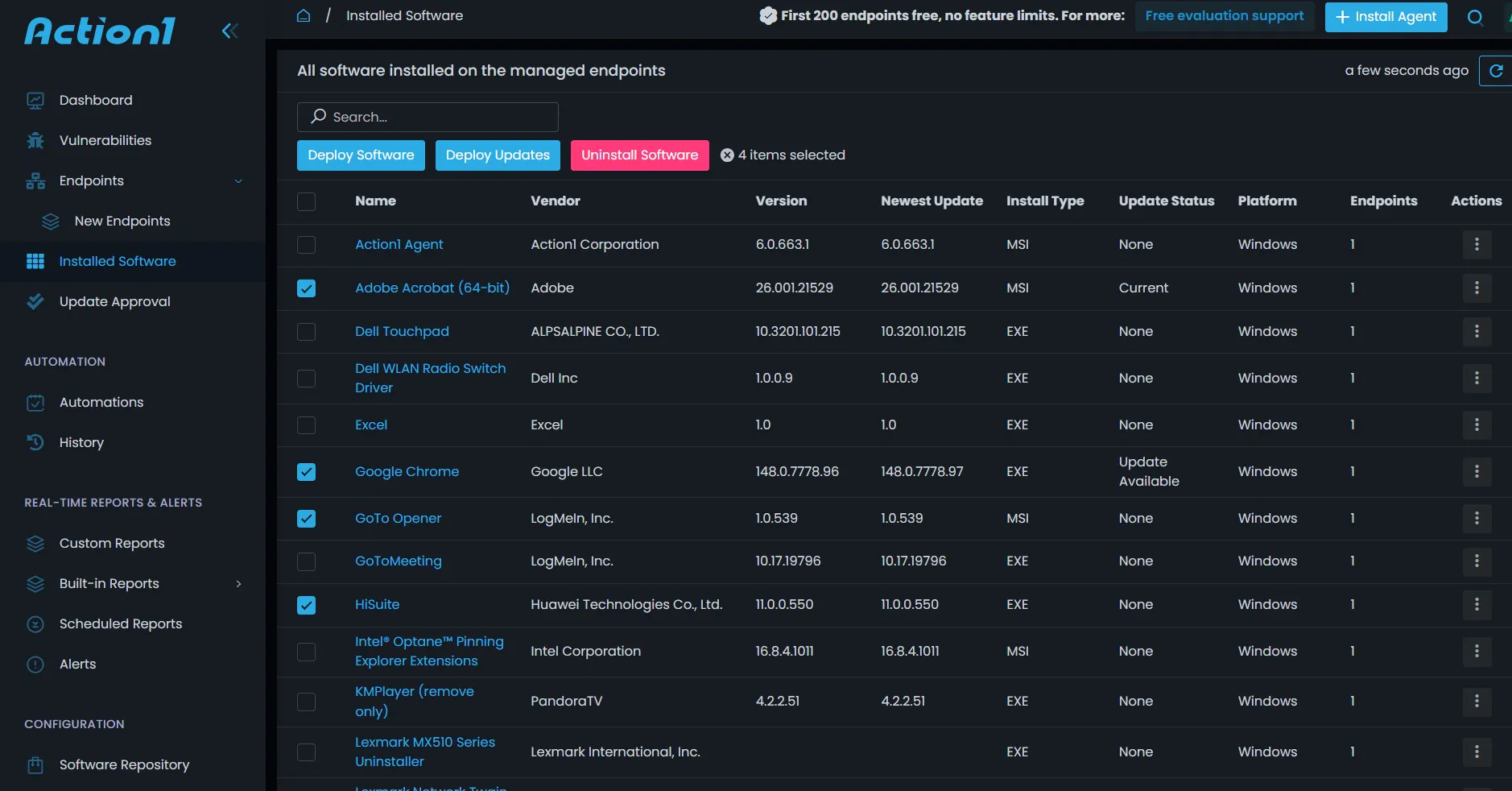
Action1 handles both OS and application updates from a single console. It supports automated patching for Windows, macOS, and Linux. Moreover, it includes a pre-tested repository for dozens of common applications (like Chrome, Zoom, and Slack). This is a relief for IT teams who otherwise have to manually check vendor websites for updates.
Real-Time Monitoring and Vulnerability Prioritization
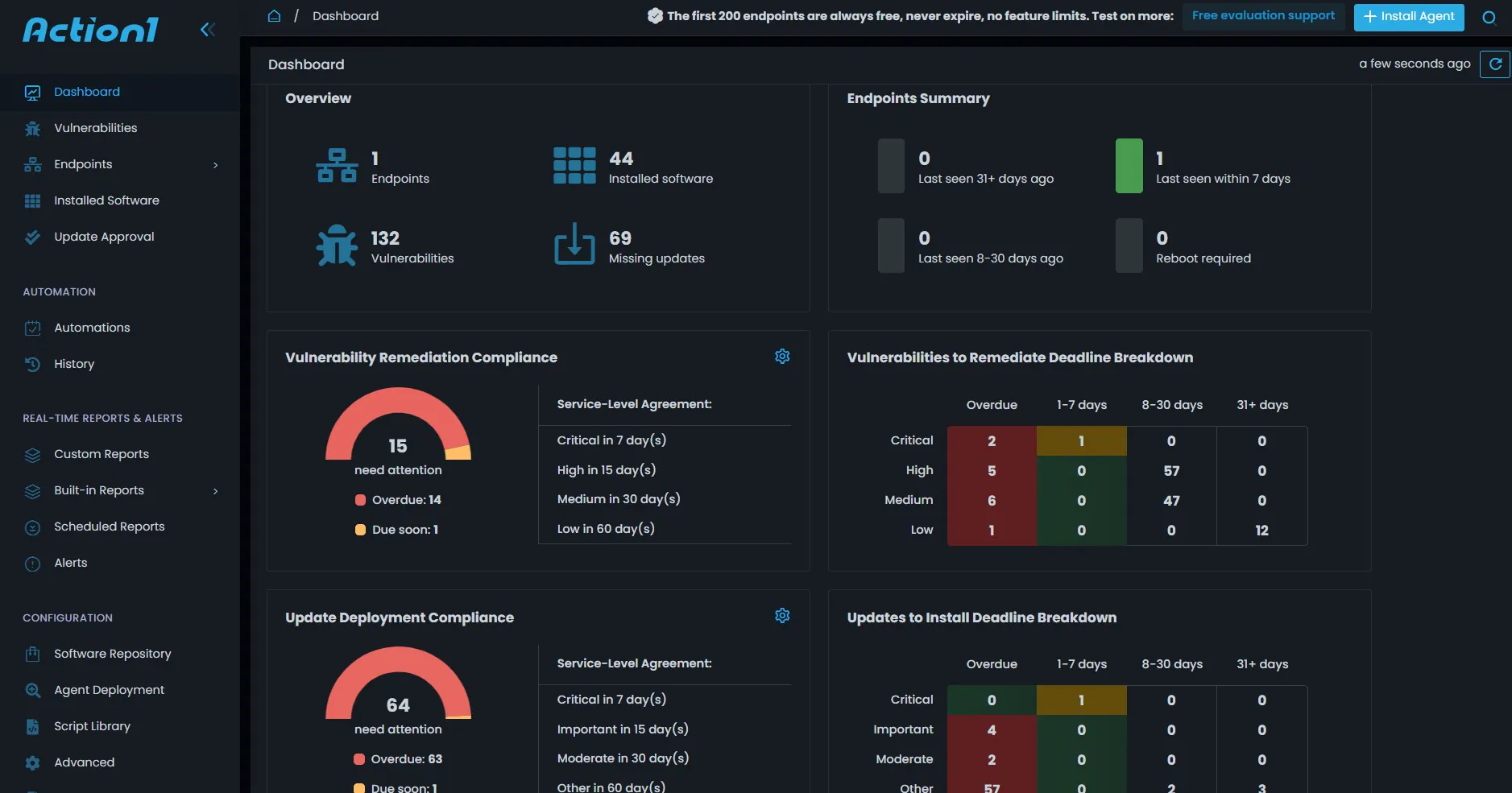
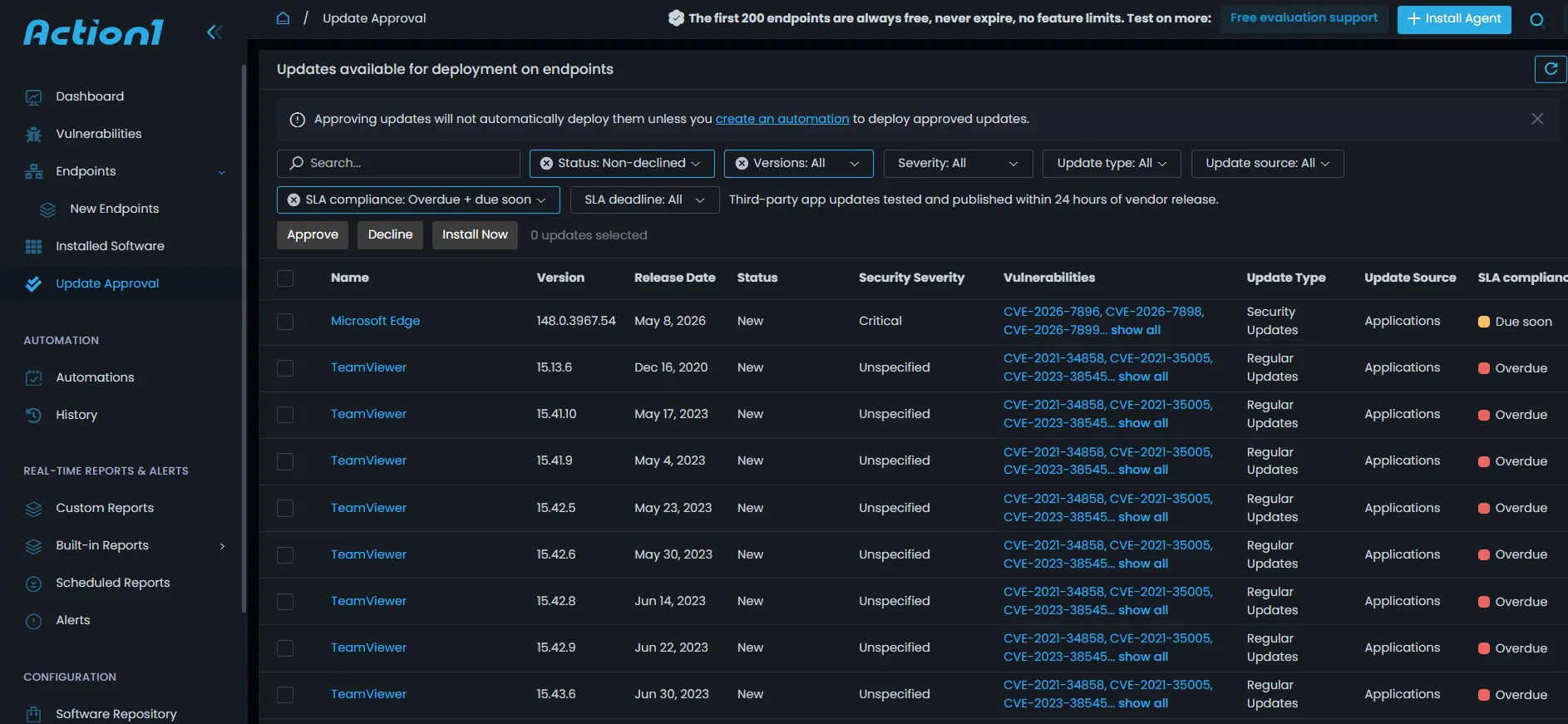
Rather than just giving you a long list of missing updates, Action1 helps you focus on priorities by integrating threat intelligence. It identifies if a vulnerability is listed in CISA’s Known Exploited Vulnerabilities (KEV) catalog or is currently being used in active ransomware campaigns. It also provides CVSS scores alongside contextual scoring, allowing you to prioritize high-risk patching.
Automation with Patch Assurance
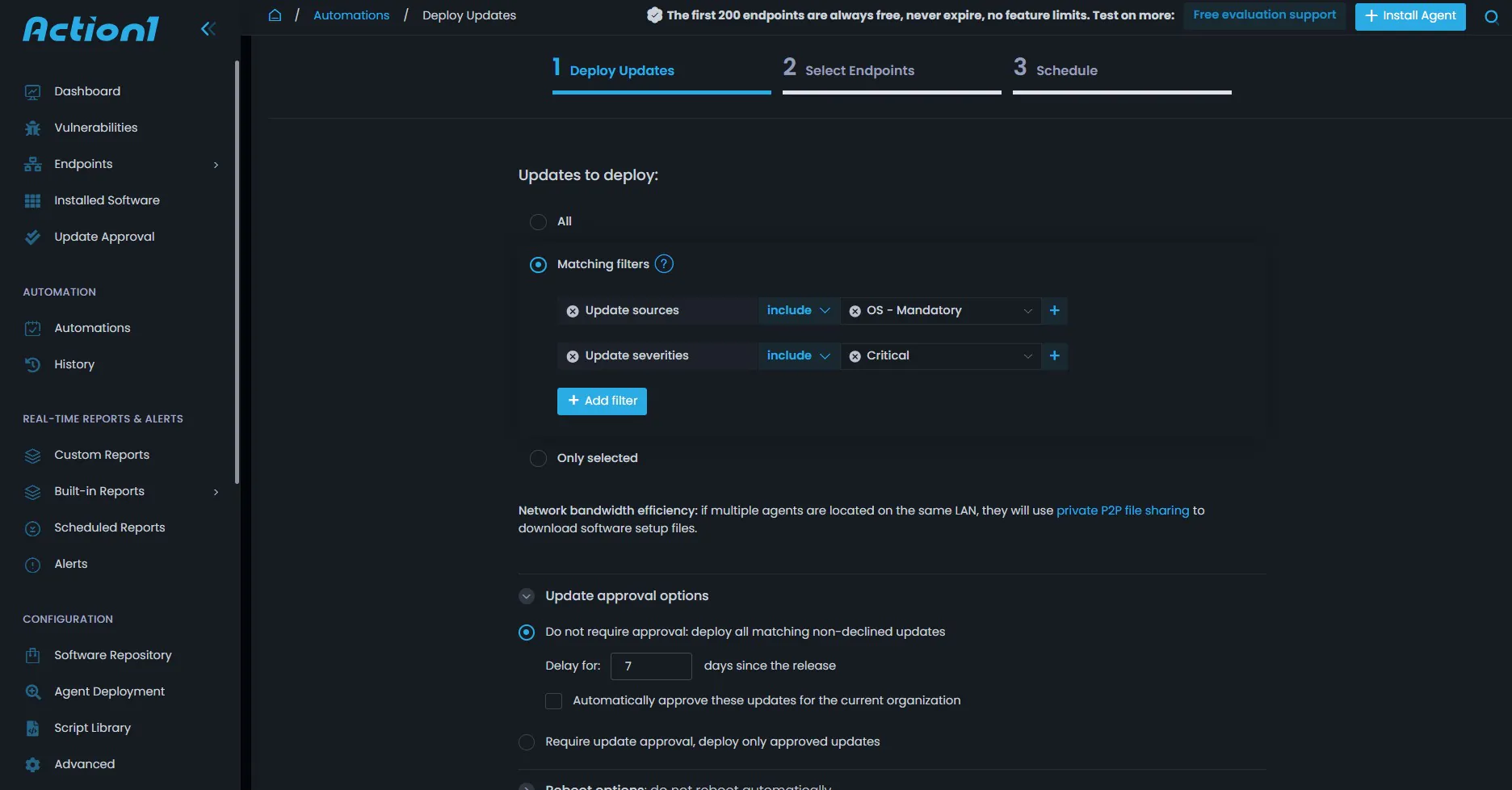
Action1 aims to remove manual work that leads to errors. It automatically discovers and inventories every hardware and software asset on your network. You can also create ‘update rings’ with specific rules for phased rollouts (for example, test on the IT department first, then wait 3 days before rolling out to Finance) and schedule deployments for specific times to minimize operational impact.
Compliance and Audit Readiness
For regulated industries, Action1 provides compliance reports that give a real-time view of your patch compliance rate. Every action is logged, providing a clear audit trail of when a vulnerability was detected, when the patch was approved, and when it was installed on each device.
FAQs related to OT Patch Management
What is OT vulnerability management concerned with?
OT vulnerability management is about identifying, monitoring, assessing, and mitigating weaknesses across industrial control and OT assets. It encompasses supervisory systems, controllers, and field devices that manage physical processes in manufacturing, energy, utilities, and critical infrastructure. It involves cataloging vulnerabilities, understanding their potential impact within your organization’s operational context, and taking appropriate action to reduce that risk.
Is vulnerability management an OT and ICS issue?
Vulnerability management is an OT and ICS (Industrial Control Systems) issue because unaddressed weaknesses in industrial systems can expose critical processes to cyber threats, operational disruptions, safety incidents, and downtime. By managing vulnerabilities, you can reduce these risks while supporting the reliability, availability, and safety of industrial operations.
OR
OT and ICS (Industrial Control Systems) environments present unique challenges that make vulnerability management more complex than in traditional IT settings. These environments include diverse devices, so vulnerabilities can affect many different assets in different ways. Common IT practices like active network scanning can disrupt sensitive industrial processes, while manual patching cannot keep up with the growing number of vulnerabilities. On top of that, mishandling a vulnerability or applying a patch incorrectly can lead to data loss, equipment damage, downtime, or operational shutdowns.
How are vulnerabilities rated?
Vulnerabilities are commonly rated using the Common Vulnerability Scoring System (CVSS), which assigns scores from 0 to 10 based on three groups of metrics.
- Base metrics evaluate the inherent characteristics of the vulnerability, including how it can be exploited, the access or authentication level required, and its potential impact on confidentiality, integrity, and availability.
- Temporal metrics adjust the score based on factors that change over time, such as the availability of exploit code or remediation.
- Environmental metrics allow organizations to tailor the score to their specific environment, accounting for compensating controls and the importance of the affected asset.
What are the limitations of CVSS scores?
CVSS provides a useful baseline for assessing vulnerability severity, but it has limitations. Scores are calculated based on the general characteristics of the vulnerability, not on the specific context of any given organization. For example, a vulnerability with a moderate score may require urgent attention if it is actively being exploited in attacks targeting your industry. For effective prioritization, you must layer threat intelligence and operational context on top of CVSS scores.
Conclusion and Key Takeaways of managing OTs
OT patch management is not a simple problem, and it does not have a simple solution. It is a discipline that demands OT-specific knowledge, a well-defined and repeatable process, and the right combination of automation and human judgment.
Organizations that do it well share a few common characteristics. They start with comprehensive asset visibility. They use risk-based prioritization that incorporates CVSS severity, threat intelligence, and operational context. They deploy patches through controlled, phased processes with rollback capabilities built in. And they treat documentation not as a compliance afterthought but as an integral part of the workflow. The combination of the right people, processes, and enabling technology is what makes that possible. Patching, done right, is one of the most concrete and measurable ways to demonstrate that your OT security program is working.