





General Overview
The Action1 Connector for ServiceNow CMDB provides CMDB enrichment by supplementing existing CMDB records with endpoint inventory and operational context from Action1. The connector is designed to work with native ServiceNow mechanisms, including IntegrationHub ETL and the Identification and Reconciliation Engine (IRE), to align Action1-managed endpoint data with CMDB in a controlled and transparent manner.
By enriching CMDB with hardware inventory and operational status indicators, the connector enables a consistent and up-to-date view of managed devices directly within ServiceNow ITSM workflows, without requiring users to leave ServiceNow to access endpoint context. Action1-specific operational data—such as agent status, patch posture, and vulnerability indicators—is stored in a dedicated Action1 Device table linked to standard CMDB Computer records, preserving CMDB structure while extending its usefulness for IT operations and service management use cases.
The enriched dataset can be used within ServiceNow ITSM processes and workflows to support visibility, prioritization, and automation scenarios.
Integrate Action1 with ServiceNow Today
What Gets Enriched
The connector enriches CMDB with Action1-provided endpoint intelligence while keeping standard CMDB classes clean and extensible.
Core device inventory
- Operating system and version
- Hardware characteristics (CPU, memory, Video)
- Serial number and last seen timestamp
- Creation of Computer records in CMDB when Action1-managed endpoints are not yet represented, based on identification and reconciliation rules
Network context
- Network adapters
- IP addresses
- Logical relationships to associated Computer records
Action1 operational intelligence
- Agent presence and version
- Patch and update posture (for example, missing critical updates)
- Vulnerability indicators and online status
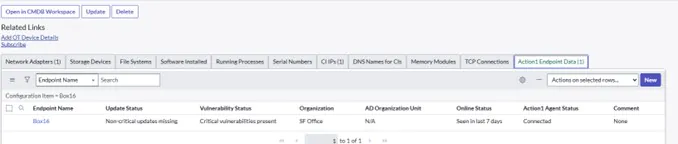
Action1-specific data is stored in a dedicated Action1 Endpoint table linked to the corresponding Computer record. In the CMDB user interface, this information can be exposed as a related list or separate tab on the Computer record, providing immediate visibility into key operational indicators. From there, users can navigate to the Action1 Endpoint record to access additional Action1-specific context, while standard CMDB classes remain unchanged and clean.
Why This Matters for ITSM & Service Desk
Service Desk teams are traditionally reactive: no ticket, no action. At the same time, they often lack access to endpoint-level visibility that would help them quickly assess impact, prioritize work, or validate remediation.
CMDB enrichment with Action1 changes that dynamic.
With enriched CMDB data available directly in ServiceNow, teams can:
- Understand device health, exposure, and readiness at a glance
- Prioritize incidents based on real endpoint conditions rather than assumptions
- Reduce time spent gathering basic system information from multiple systems
- Act with greater confidence knowing CMDB data reflects current operational conditions
As a result, CMDB evolves from a passive record store into an actively used operational asset that supports day-to-day IT service delivery.
Example Use Cases Enabled by CMDB Enrichment
Dashboards and visibility
- Devices not reported for a defined period
- Indicators of missing critical updates
- Presence of critical or high-severity vulnerabilities
- Reboot-required conditions
- Agent version distribution across managed devices
Operational automation (pattern-based)
- Use updates to Action1 Endpoint records as triggers for condition-based workflows
- Create incidents or tasks when defined operational indicators change
- Initiate remediation or notification workflows using Flow Designer or Playbooks
- Support lifecycle actions, such as identifying or managing inactive or stale device records
From CMDB Records to Operational Decisions
Rather than introducing another tool for Service Desk or IT Operations to learn, CMDB enrichment with Action1 brings actionable endpoint context directly into existing ServiceNow workflows. This allows organizations to start with visibility and then incrementally introduce automation where it delivers the most value – without disrupting established ITSM processes.
CMDB enrichment is not about replacing ServiceNow capabilities, but about making them more effective by ensuring the underlying CMDB data reflects real operational conditions.
Architecture Note: Creation vs. Enrichment
The Action1 Connector is designed to enrich existing CMDB records whenever possible, while also supporting the creation of new Computer records when Action1-managed endpoints are not yet present in CMDB.
Endpoint data retrieved from Action1 is processed through IntegrationHub ETL and evaluated by the Identification and Reconciliation Engine (IRE). Based on configured identification criteria and reconciliation rules, the connector will either enrich an existing Computer record or create a new one in CMDB. This behavior ensures alignment with established CMDB governance practices and avoids uncontrolled record creation.
Action1 does not replace CMDB as a system of record. Instead, it acts as a source of operational context that complements existing CMDB data and makes it more actionable within ServiceNow ITSM workflows.